I’ve been pretty quiet with the promotion of Loose Ends I’m just letting it roll out all over the world — yes you can download an e-book copy or order a paperback copy from several places including Australia and New Zealand!
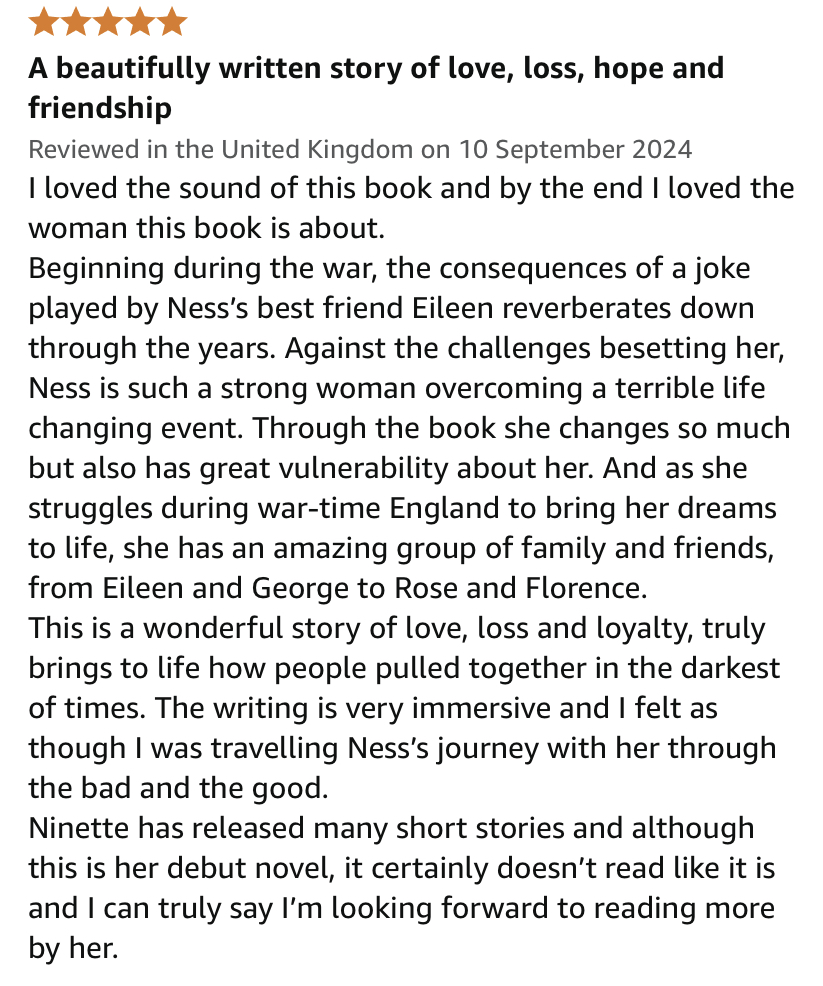
Right now the book is featured on Zooloo’s Book Tours and I’m pleased to say that it’s going rather well. It is running from now until 19th September. You can read the reviews as they come in and are posted on Instagram, X, Facebook and Threads. Or you can follow me on any of those platforms as I repost each one — hoping not to miss any. I was rather pleased with this one that came in yesterday:
And this one from the day before:
I hope that if you haven’t yet purchased a copy of Loose Ends that this will encourage you to give it a go. If you have read it and enjoyed it then please put a review on Amazon or Goodreads. . . every little helps 😊 Talking of reviews, I was rather intrigued to read the AI generated paragraph (shown below) on Amazon 😊 Not sure what they mean by the writing quality being ‘agonising’ ha ha
You can click on the title to buy the book LOOSE ENDS
The posters below show the dates and those reviewing…
Thanks for reading this post. You can check out my Substack…Click HERE for the latest newsletter. It’s all about our trip to England in August.
As I struggle with writing my second novel I find myself in a strange situation. I don’t exactly have writer’s block, but I’m finding that I have to dig deep for the inspiration to get on with it. I often join the Writers’ Hour on the London Writers’ Salon. It’s an online silent writing session where a few hundred writers (today it’s 245) sit in their own home, coffee shop wherever and just write for 50 mins. It is an inspirational space and I’m there right now writing this blog post. I hope that when time is up this morning, I will be able to carry on writing for the following hour at least and maybe pick up that WIP (work in progress) and get on with it.
Each morning they read out a quote and this morning (23/07/2024) it was this: “[I don’t compare myself to other writers] I think it’s really important that you do your work. Sometimes there can be a little bruised feeling when you see others shooting ahead in sales or profile. But I’m doing the thing I need to do, and doing it as well as I can. It’s a vocation: I’m doing the thing I’m for in the world; and that is a great feeling, no matter what happens.” – Melissa Harrison, in an interview with Dominic Dean
When I wrote Dear Tosh, Cathy Rentzenbrink was my mentor and she always said, ‘compare and despair’ which I think is an extremely good motto even though it’s difficult to stick to, and it doesn’t need to relate just to writing. It’s hard not to compare oneself with others but I think that’s half my problem. Instead of getting on with the writing, I’m spending too much time looking around at how ‘successful’ others are in this fickle world of publishing. Loose Ends has had some great reviews and I’m happy with the way it’s selling and getting out into the world. Of course, the promotion of it takes time and I have, for the time being, taken a short break from all that social media and ‘putting myself out there’. I will be back to that in September when, in fact, there will be a blog tour. More about that another time.
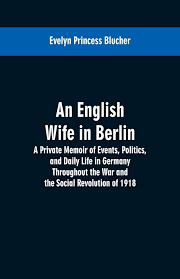
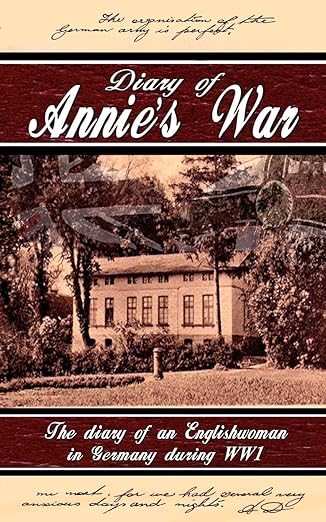
My next novel is called Frieden but that’s just a working title. I don’t think it will be released under that name because the story has changed so much since it was first conceived, the word frieden (freedom) is not relevant anymore. It’s set in Berlin Germany, from the outset to the aftermath of WW1. I have enjoyed the research for this book tremendously. I have read two contemporary diaries written by English women who were in Germany at the outbreak of the war. One is An English Wife in Berlin by Evelyn Princess Blucher and the other is Diary of Annie’s War by Annie Dröege. She too is English but married to a man of German heritage. Her story is particularly interesting because her husband Arthur was a British National living in England but when his uncle died, Arthur was the oldest living male relative and he inherited everything including a manor and vast estate in Lower Saxony Germany. He and Annie moved to the property, and were reasonably happy but when war broke out Arthur was interned because of course, he was a British National. Both of these diaries make very interesting reading and have been most helpful in my writing of the book.
Writing can be a lonely business. Another reason it’s often difficult to get going. But thank goodness most writers are gregarious and friendly. I belong to a couple of online groups who meet up every two weeks or once a month and I find these essential for sharing work, motivational conversations and just generally boosting confidence and getting rid of that inner self doubt, which we all have.
I also love joining the Writers’ Hour and I writing this blog post this morning whilst online with the LWS was the best thing I could have done. Just writing about my writing is enough to motivate me into a more proactive day and week going forward. In August we’re going to England for a couple of weeks and I must not let my writing slip into the back seat again. When I’m there I’ll be able to join the Writers’ Hour at 8am, which I must say I find a lot more convenient than the 9am – 10am in France!
I am aiming to publish my next novel in March 2025 which will be one year after I published Loose Ends if I can do it any faster I will but there’s no rush really. One book a year is enough I think. Although looking around I know others often do two or even three but . . . COMPARE AND DESPAIR — don’t do it!
I’m pretty new to this self-publishing lark on Amazon and I’ve done a few things A about F. I’d intended to post a link on here today for a free giveaway of the e-book via Booksprout but discovered, at the last minute, that I could only do that PRIOR to the e-book going live on Amazon, which it did last Monday so I missed the boat and so did you. But, no worries you can still download it for a small amount and if you’re a member of Kindle Unlimited you can download it for free. The paperback book is also available so you have a choice.
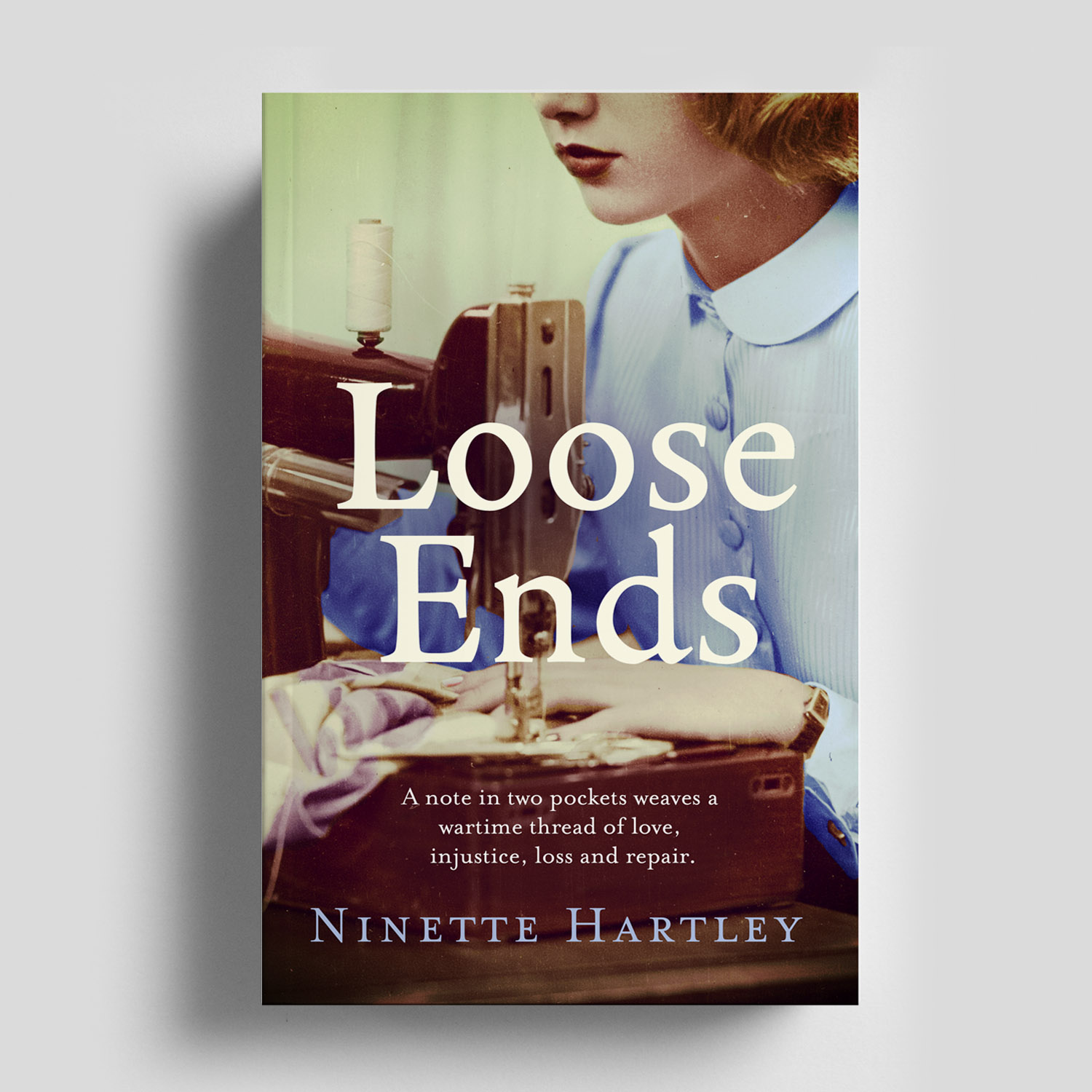
Above is the fabulous book cover designed by Emma Ewbank To order the book you can click HERE and it will take you to your Amazon location for the paperback. Click HERE for the ebook version.
Promotion is such a difficult thing and I’m hoping that lots of you will help me spread the word about my debut novel. It’s a good read and a page turner, according to The Man. It’s historical fiction/romance with a little bit of ‘mature’ content in it but nothing gratuitous. I don’t want to give away any spoilers so I’m choosing my words carefully.
You can watch a little book trailer HERE on my YouTube channel and while you’re there please subscribe to the channel and you’ll be notified when I post a new video., for example next week there will be a chance to watch an interview with me recorded on Zoom. I’ll keep you posted here or with my Newsletter or on the social media platforms.
Could I just add this little plea. . . ‘If you buy the book and read it, in whatever form, please give it a review either on Amazon or Goodreads or on FB, Instagram etc., It’s the only way that self-published authors can raise their profile and increase their sales. Thank you so much’.
Not too many words today just a wonderful picture of the front cover designed by the wonderful Emma Ewbank. I’m looking forward to sharing publication and launch dates with you all soon!
On Thursday, 9th August, I attended the first of five sessions to learn ‘how to deal’ with social media. The course, Content Compass Bootcamp, is run by the amazing Joey Clarkson, whose energy and versatility encouraged us to participate fully in every exercise she set. We were given monthly planner sheets and post planner sheets and a veritable wealth of information to help us up our social media presence and build confidence in our brand, product, writing project. . . or whatever it is we are working on or towards.
Putting into practice what I’d learnt, I uploaded a video to Instagram a couple of days ago. It was about those pesky words we writers use too often. I was searching my WIP for the word ‘that’, which I know is a horrible word, and I use it too often. I tend to write things like:
She thought that he was staring at her. The word that is totally unnecessary. She thought he was staring at her is sufficient and reads much better.
I don’t know why I do it, but I found over 1000 ‘thats’ in my 83,000 word manuscript.
The video went out to the public as a reel, and to my astonishment, it was watched (to date) over 2,000 times, and I gained 30+ followers in twenty-four hours. Which is amazing. The thing is, I know I have to keep this up and that is where the Planner Sheet and the Post Planner Sheet come in handy. I now have to post regular content to social media at least three times a week. This blog post is will be my second post for this week and I have to do at least one more before Sunday. . .Yikes! I think the best way is to make videos and prepare content in advance which I’m trying to do. This last week was a little difficult because I was on Nonna duties, and my days were taken up with the grandchildren, which of course was a pleasure, but left me less time than usual to get organised. But, I’m making excuses!
Gotta dash now. . . I have to make a video, take a photo and write some content before I head off for a pedicure at eleven. Well, you have to keep things in perspective don’t you?
‘On Monday I had more or less decided I was not a novelist, by last night I had changed my mind. Didn’t expect that!’ This is a quote from ME on the last day of the course.
Before I wrote and published Dear Tosh I began writing in other genres, specifically poetry, short stories and flash fiction. Simultaneously, I drafted two novels, neither of which I actually finished. Well, that’s not strictly true, I finished one then decided it was garbage so put it in a drawer to be forgotten. The other one was unfinished and lay dormant on my computer. There was something not quite right about the premise. I signed up to the Mslexia Novel School, decided to wake up this work in progress and make one last effort at completing it.
From the 11th until the 15th July, I was one of forty odd women who signed up for the online Mslexia Novel School. Every morning for the first half-hour, all the attendees appeared on screen. Rosie Garland talked us through a warm up of writing exercises and ‘chat’. Again in the evening for the last hour, either Rosie or Bec Evans took us through a winding down session. During the rest of the day we were divided into groups of 10 or 12. It was a full on week from 9.30 until 18.00 each day. Four different tutors for workshops covering a variety of novel writing topics.
It was a brilliant week. My group bonded and encouraged each other with constructive feedback on the work that we produced throughout the week — and there was plenty of that — and ideas we all had for new novels or suggestions about our work in progress. It is truly wonderful how supportive other women writers can be. My group are still in contact via WhatsApp and plan regular Zoom meet-ups. How good is that?
Each tutor had put together interesting and informative workshops. They used examples of work from well known books and authors and crafted some clever exercises to expand our ever hungry desire for knowledge. I’ve given a quick list of the tutors and if you want to know more about them you can click on the links.
Voice and POV was run by Margaret Wilkinson a quietly spoken women who taught me not to be afraid to play around with viewpoint and voice until I hit on the one best suited to the piece of work I was writing.
Creating Character was Lesley Glaister who struggled with a sore throat but that didn’t stop her from imparting some great tips re character building including making a connection with an object and a character. I chose a bag of old soap slivers, and invented a troubled young man. Can’t share it because I’m editing it with a view to entering it somewhere.
Pace, Page Turning and Plot fell to Livi Michael. I have to thank Livi for my lightbulb moment of the week when she made me see the weakness in my plot and also turned the few sentences of my ‘pitch to an agent’ into something far more interesting and exciting.
World Building was led by the effervescent Leone Ross was both scary and incredibly enthusiastic. She made us step right out of our comfort zones, stretching our imaginations, in order to create some amazing new and quite different worlds.
I gained something from every tutor during the week and from the hosted discussions held with Rosie and Bec for the whole school on the last day. Rosie shared her journey to publication telling us about her multiple rejections before eventual acceptance. She was the winner of the first Mslexia Novel Competition. What an inspiration she was. We were all in awe. Thank you Rosie.
If you are a woman and considering joining a novel writing course next year, I can recommend Mslexia. Check out what else they have to offer here
Last Thursday, rather late to the party, I signed up to attend the Flash Fiction Festival for just one day – it was absolutely brilliant and I wished I had realised earlier that it was on. I would have attend the whole weekend, from Friday 7th July until Sunday 10th, but as you know, if you read my last post, I’m already committed to a week long online course with Mslexia Novel School starting tomorrow (11th July) and I thought I would not be able to cope with a full weekend ahead of that.
Trinity College Bristol – Venue for the Flash Fiction Festival 2022
The Flash Fiction Festival was full on with some terrific workshops, readings, panel discussions and other activities (I missed out on the karaoke on Friday night but I’ll be there next year!) The house was a perfect venue with beautiful grounds in which to relax or explore. Lots of trees for shade which was needed this year.
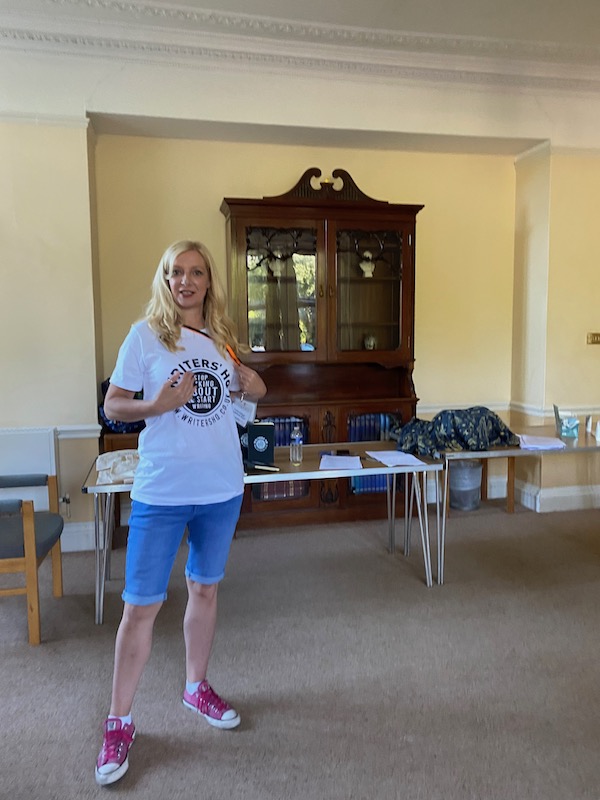
Kathy Hoyle from Writers HQKathy Hoyle showing us how it’s done
The first workshop I did was with Kathy Hoyle from WritersHQ She ran a fast and furious session when participants had to pick a genre out of a hat — hopefully one they didn’t normally write in — two opposing prompts given: ACCIDENTALLY v ON PURPOSE. We were then given twenty minutes to write a story of up to 500 words. By the way, a ‘Flash Face Off’ is run each week on their website. Kathy Hoyle was an enthusiastic and energetic workshop leader and brought out the very best in us…I even ‘won’ a book because I stood up and read out my short piece, which was okay but will benefit from some editing and a better ending! I picked Magic and Myth from the bowl, definitely not my usual choice of genre!
After a coffee break everyone took part in a ‘Word Cricket’ session with Vannessa Gebbie. She started us off with a sentence and we began, with instruction to write quickly and continuously. Every now and then she threw us a random word and we had to immediately insert it into our writing. I had done this before and it’s great fun. It’s amazing the variety of stories that can be created in a very short time.
I absolutely loved the second workshop I attended with Carrie Etter she was a brilliant facilitator. The title of the workshop was ‘Writing the Prose Poetry Sequence or Series’. It was an hour and a half long and it flew by. I could have done a whole day without any problem. She introduced us to a couple of prose series, the first was from Nina Andrews’ The Book of Orgasms (Bloodaxe, 2003) I thought I might feel uncomfortable with this subject, but no, they are light hearted and very clever. I laughed a lot and even read one out loud when asked. Great fun. Sorry I can’t find a link to share these poems. The second example Carrie gave us was from Hilda Sheehan’s debut pamphlet, Frances and Martine (Dancing Girl, 2014). Another series of amusing prose poetry with anecdotes about two middle aged friends. You can get a glimpse here .
We were given the chance to think about and create our own series of prose poems. The idea was to create say three prose poems using one of the following prompts: The Gaze, The Kiss or The Whisper. For example if you chose the kiss you might think of writing the following poems: The Kiss at the Barrier, The Kiss of the Reptile and the Kiss of Death. Get it? The option to expand is endless.
We then went on to talk about Prose Poetry Series, which differ from the above because each poem continues from the poem that comes before it. The example we worked from was Rosmarie Waldrop’s White Is a Color (Guillemot, 2017. It’s 19 short prose poems that tell the story of the speaker’s husband’s fall and recovery. It’s very good.
I am enthused to create some of my own prose poetry series or sequence…watch this space.
During the afternoon I attended a panel on Writing Historical Novellas-in-flash. A very interesting discussion and informative. I was never quite sure what constitutes a novella-in-flash. I thought it had to be a series of flash fiction stories that stood alone but with a story arc. I learnt that each flash-fiction should not exceed 1000 words —but they sometimes do — they don’t ALL have to stand alone but usually a good percentage of them do. There doesn’t have to be a story arc but there should be some connection between them. This is what I now understand, but I’m sure others will say something different. It seemed to me that the ‘rules’ are there to be broken.
My last workshop of the day was with Michael Loveday, ‘Writing the Novella-in-flash: Developing your characters’. I have to admit to being pretty exhausted by this point and could not really focus as well as I had earlier in the day. But, it was a good workshop and Michael gave us all several handouts to take way and use at home. Thank goodness ….I’m going to use his many tips for getting deep into my fictional characters. I think the worksheets might come in handy for my novel school next week!
I’m going to leave you with this photograph… how and why do you think that little yellow duck ended up on the top of the dresser? I have no idea but my eyes kept being drawn to it during one workshop.
It is now well over twelve months since I published my memoir Dear Tosh and during that time I have not finished any other work in progress. I have two novels on the go — actually three — but none are anywhere near finished. I also began, in earnest, to write a memoir about my life in Italy but this fell by the wayside when I realised that it was probably not going to be of interest to anyone. It’s been done too many times before. I have to think of a different angle for it rather than a series of anecdotes about being an expat abroad. Quite a few poems were created or edited over the last few months but nothing good enough to put into a pamphlet, at least not yet. Also, a radio play which has been put in a drawer then pulled out and edited several times over the last ten years! I am, if you like, in a state of ‘half-dressed’ with everything I do, and I find it a lot easier to choose clothing and complete my outfit than to bring any of my WIP to a satisfactory conclusion.
In an attempt to actually finish something, I’ve signed up to the Mslexia Novel School next week. It’s an online course from Monday to Friday aimed at those of us who want to — but don’t seem to be able to — begin or finish a work of fiction. I’m a believer in courses, any courses; online, in person or a hybrid of both. On the whole I find them inspiring and I need the interaction with tutors and other writers to keep me motivated. I know that sometimes feedback can be harsh and often full of words you don’t want to read or hear but you have to learn to pick out the more objective notes and take them on board.
I have an MA in Creative Writing and I facilitate creative writing sessions on a regular basis, but that doesn’t mean I don’t need to attend writing courses myself. I believe that you can ever stop learning.
I’m full of enthusiasm and can’t wait to get going. . . I’ll update you at the end of next week as to how the novel writing course went.
The English Girl In Leningrad was published at the end of April this year. The author Anna Wooster agreed to answer some questions for this blog. I think you’ll find her answers fascinating. Anna’s story is the kind of story people want to read. It’s interesting from the point of view of Russian history, and Anna’s personal account of life as a ballet student in the Eastern Block during the cold war. Read on to find out more. . .
Tell me a little about yourself and life today.
In a way my life underwent a big change with Covid 19. Not because I caught it but because it coincided with a heart problem I had which interfered with my teaching routine. Simultaneously the ballet school had to close down because of the lockdown imposed in Italy. With ballet schools closed for practically two years, my class of senior secondary school girls dispersed; mostly gone on to university. However now I still give a weekly class and theory session to my group of four teachers who run the school, teaching children from 3 to 14, in six separate groups. I help with performances, and revive some of my choreography and rehearse my teachers when they dance themselves.
Apart from the school I seem to be as busy as before but there is far less to show for it. Writing the book was very time consuming and getting it actually printed was the most stressful part of it. We have a big house and let two flats as Airbnb accommodation which takes considerable energy and organisation and then we have an enormous garden, with flowers, lawns, vegetable patch, fruit trees and twenty olive trees which supply us with delicious oil all year.
My husband is on pension but since his retirement he divides the chores with me and takes the whole responsibility for the olives and veg patch. Our large extended family is scattered all over the world with a daughter in Australia, a son in Portugal, a grandson in Australia, another in America, and yet one more in Scotland. My eldest daughter, and her eldest son fortunately live only half an hour away from us.
Did you always want to be a ballet dancer?
Yes. Like many little girls I said I wanted to be a ballet dancer even before I really knew what that meant and even less what it entailed. I needed to do something completely different from my brothers. As I grew older and luckily found an exceptionally valid ballet teacher in Mrs Nina Hubbard my wish to do specifically ballet grew and with it a particular delight in doing ‘improvisation’. This was a field where I didn’t have competition from my brothers and where academic abilities didn’t come into play. At primary school I was what they called ‘a late developer’. I was slow to read, hopeless at arithmetic, and a lousy speller. However by the time I finished secondary school I had seven GCEs including English language, literature, maths, and French. The more ballet classes I did the better my academic work became. When I went to Warsaw for the Youth Festival aged 14+ in 1955, I knew I wanted to be a ballet dancer and no-one could discourage me. This one-mindedness has been a deciding factor in my life.
Tell me briefly, for my blog readers who don’t know you or the book, how you came to be a student in Russia please. I believe your father had a great deal to do with it. By the way he sounds like a wonderful man, I should like to have met him.
Yes, my dad was a wonderful person, and without him I would never have made to Leningrad. Mrs Hubbard was Russian and taught ballet pre-Vaganova Russian style. She was the one who encouraged me to aim at studying in Leningrad. My father read an article in the Times, written by a Russian diplomat saying that peace and understanding between nations would be increased with the exchange of students of science and the arts. Answering this appeal my father asked if the desire of his daughter to study ballet in Russia certify for this possible exchange. To cut a long story short, this beginning led to me being given an audition to the Bolshoi school during the Moscow Youth Festival of 1957, which finally enabled me to go to the Vaganova Academy in November 1957.
The training you received in Russia was very different from anything in the west and when you returned to England you found you could not fit in. Tell me about this.
The attitude to ballet in the Soviet Union was totally different to the attitude in the west. In Russia ballet was a main stream art, in England then, it was considered elite entertainment. I came home full of hope, anxious to put to use the accomplishments I had achieved, only to realise bit by bit that they were not what was requested. All my friends, teachers, acquaintances, contacts , were left behind the Iron Curtain. There was no-one to guide me, advise me, encourage me. Coming straight from the Vaganova Academy, from being pampered and looked after by dedicated teachers, from working in the best possible studies and theatres, I found myself rehearsing in church halls with terrible floors, rickety barres, no mirrors with ballet masters that seemed to me to give classes that tied me up in knots. The impact of cultural shock that hit me was gradual in its undermining power to destroy self-confidence, however, slowly but surely it eroded my very will to live: I was on tour in Chester, poised on a landing leading down to the river Dee ready to get finished with it all, when a casual call from a colleague “Coming for a drink Woos?” changed the course of things.
You say in your book that you had to choose between being a ballet dancer or marrying the love of your life. Because you felt dance was a vocation and demanded your whole self. How did you find combining being a ballet teacher with being a wife and mother?
On marrying I decided that ballet would not be my one and only object in life. However three months after settling in Riva del Garda in collaboration with the local music school I opened my first ballet classes for girls.
I decided right from the beginning that the ballet school would not be another all-absorbing career. I never programmed lessons at the weekends, nor taught after 7pm in the evenings. School summer holidays, Christmas, New Year, Easter, were all dedicated to the family, and I kept one weekday free from teaching so I could do things with my kids. That said, life was a bit like a merry go round; school, kids, husband, house, garden. Sometimes one would have priority over the others, for example when the annual school performance came up at the end of May beginning of June, everything else took second place. But preparations for Christmas, making of cakes, mincemeat, puddings etc the precedence changed. My two girls and my son all did ballet with me, the eldest up to a teaching diploma, and the second daughter up to advanced standard. My son danced until he was 12, then he oped for other activities, ski-ing, sailing, tennis and football that he started when he was 8. My husband collaborated with the school in a practical manner, helping with the maintenance of the studio, lending his secretary to keep the books, driving the van with costumes to the theatre, making scenery, you name it.
Have you now completely retired from teaching?
As I said earlier I still teach my group of teachers, and conduct the odd rehearsal. The lessons offer a good opportunity for them to ask any queries they have about their pupils, or doubts on how some step should be performed. They ask me my opinion concerning their choreography, and particularly advice on making costumes. Life has changed, pupils have changed, attitudes have changed, parents have changed. I have great admiration for my teachers who face many difficulties and obstacles that didn’t exist in my day and accept they must adjust to the times in order to survive, nonetheless they do so still upholding my principles.
Have you always thought about writing this book or did it only come to you recently?
No, I had never thought of writing a book. I had a very low opinion of my literary abilities, although I enjoyed essay writing at secondary school. I felt my literacy in English stopped when I was 17 and went to Russia. There I learnt Russian and I must say quite a bit of English too while trying to understand Russian grammar, but I read very little English. Then when I married I learnt Italian, there again English took second place and it wasn’t as it is now with TV in any language you want. In Italy they have the habit of dubbing all films in Italian too. It was doing the RAD BADE degree on Dance in Education by correspondence that really revived my English. We had to read copiously and write many essays. Because many students were not mother tongue English speakers, and I was living in Italy maybe they took me for a foreigner, but all the professors I had contact with complimented me on my English! My morale was very boosted by this. The idea of the book was connected with my degree insomuch as it was Jonathan Still, professor of the Music for Ballet course who encouraged me to write down my recollections. I sent him a photo of me in my Russian costume, the one on the cover of the book, and a description of the costume and how I made it and the adventure of getting the materials sent from England. He was most enthusiastic so I took another photo of me in the Arabian dance from Nutcracker and wrote about how I was chosen to dance this, and the rehearsals, the costume, and finally the encouragement from Nureyev who was the Nutcracker Prince at my first performance. I showed these efforts to my granddaughter too and she was fascinated and said straight away, “ Grandma, you must write a book about it all!”
You must have mountains of notes written over the years or did you just rely on your memory?
I haven’t written notes but I did write letters home to my parents when I was there and my father kept them all and put them is order by date and scholastic year. Those are the backbone of the book. Then I am afflicted by the squirrel syndrome, I never throw away programmes, photos, letters, press cuttings nor even postcards. However there is much in the book that comes from my memory, many of the sensations, anguish, joy, trepidation, wonder are there in my mind’s eye and add flesh to the facts from the letters.
How long did it take you to write the book?
The first write up, the one about the costume I did in 2016. The others followed at irregular intervals. During Covid lockdown I put it all on the app. Scrivener with the assistance of Jonathan Still. Then it really began to take shape. It was more or less finished by the middle of 2021.
How did you find self-publishing?
That was the worst part of all. I am not computer-minded. I am more or less self-taught or maybe it would be better to say, grandchildren- reliant ! Following advice from friends, I had the book professionally edited, and then sent it to a typesetter who prepared the files for KDP as that was the only way of publishing I could afford. There were hitches, and I am not 100% satisfied with the result, but it’s out, there to be read.
That’s the important thing. So much better than leaving it on your computer. What a waste that would be.
I remember you had originally wanted to print over 100 photographs but found that wasn’t viable. It looks like you ended up with around 30. How did you choose which ones to remove? How did you choose those?
Actually there are twenty-one photos with the frontispiece. First of all I was strongly advised by my editor to remove any photos which I didn’t have copyright for, which unfortunately were photos taken by professionals and were some of the best. I took out photos of buildings, and inanimate objects. Then I allowed myself only one photo of each role I danced, and one photo of the most important people in the story. I choose the photos where I think I look okay!
Ha… I don’t blame you!Do you ever go back to Russia now? To Leningrad or St Petersburg as it is now? Do you still have friends there?
Yes, I went back to St Petersburg last time in 2005, and went back to school and looked up those friends who were still alive and still there. Many, many people, teachers, classmates, friends, have died and many others have gone abroad. I saw my character dance teacher and the French language mistress. The group photo of our graduation year 1961 is hanging on the wall on the staircase. I saw a couple of friends and visited them at home. They now work either as teachers at school or in the theatre but life has altered tremendously.
I have been to Moscow much more recently in 2019/20 to visit my son and his Russian wife and son who live there.
Have all your family read the book and what did they think of it? You must have grandchildren old enough to read it now?
Yes, indeed. My granddaughter was my first reader, she has followed all the stages and has been a continuous stimulus to write the book. She was also an excellent critic, pointing out where I should delve deeper, explain more fully, or had been ambiguous. My second daughter too read it while it was in the making and contributed with many useful suggestions but above all designed the cover. She herself is a very eclectic artist, making use of an infinite variety of materials. It was her idea to use the Union Jack and the Hammer and Sickle as a background. My eldest daughter made a significant comment, she said “I was astounded how four years in Leningrad, formed your character, made you what you are, influenced your whole life!”
That’s very interesting. Often children don’t get the opportunity to read about their parents’ past.
My eldest brother and his wife who is Russian but comes from Moldava read the book in the making. My brother corrected my English and some family details and said chapter 4 was only for people interested in ballet! His wife on the other hand was enthusiastic about it and said it painted a vivid picture of a historic period. My husband read various parts along the way but feels he knows the story anyway. He too, finds there are too many ballet technicalities for a lay person.
I have had delightful messages from other members of the family, a cousin, father of three girls aged 12, 10, 7, read the book to them and they were fascinated and asked me all sorts of questions.
The cover shows such a lovely photograph of you, in a fantastic headdress. I believe your father had something to do with it?
Yes, my dad made the ‘skeleton’ of the kokoshnik, the traditional Russian headdress, from stiff wire recuperated from the stems of a bunch of artificial roses It was very difficult to find any materials like wire; there were no hardware shops or DIY stores. The roses were given to us by the theatre, they came from the opera Carmen! He made it in such a way that it was very sturdy and didn’t wobble at all. Then I covered it with lining and then lamé and we sewed on the ‘jewels’ and made the net of seed pearls which cover the forehead.
Did any of your children want to become ballet dancers?
Fortunately, no! None of them had all the qualities/gifts necessary for a career in ballet, and although they all had good points and gained joy and satisfaction studying ballet they developed other passions. My parents were very good about letting me do what I wanted to do, going against advice from school teachers and the like, and I was adamant that my children would make their own decisions too. They did, and all chose arts rather than sciences.
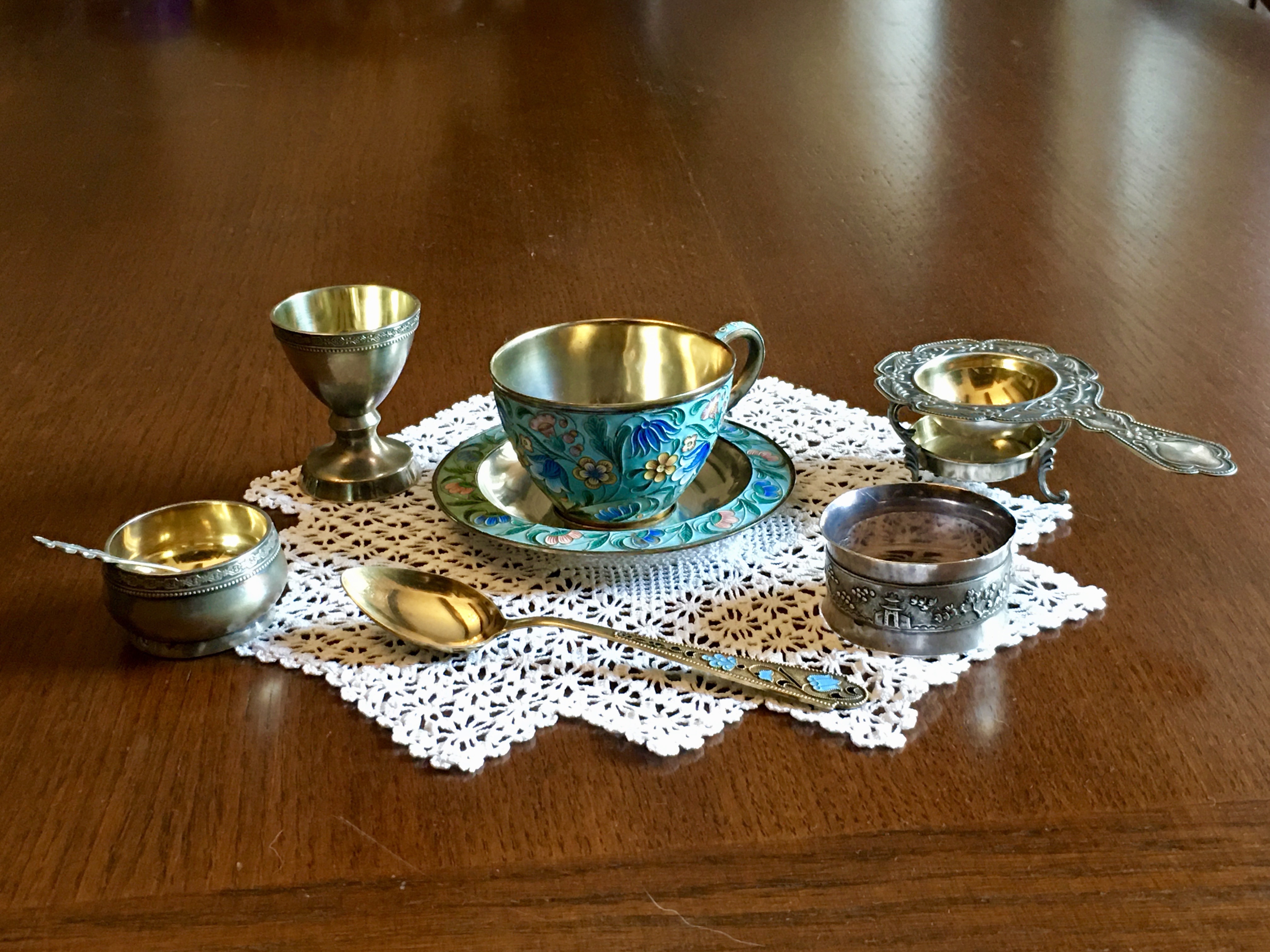
I love the story about selling all your clothing before you left and everyone wanting to buy items even if they were worn out. You bought a liqueur set as a memento. Do you still have it?
Yes, indeed! I treasure it together with the gifts that Olga Genrikhovna gave me.
Liqueur Set
Gifts from Anna’s Ballet Teacher
I understand you are at the moment translating the book into Italian, how is that going?
It is going reasonably well. I did a rough translation with the Deep L. App. And am now reading through it to correct the most blatant mistakes, (like translating ‘the rake of the stage’, as though it was a gardening rake!) But when I have done that it will need to be edited by an Italian, then typeset for KDP, which I am wondering if I can manage myself this time…. Ah! Still a lot of work to do on that, but very necessary because all my pupils are Italians and although the younger generation is much more proficient in English than former ones, none of my teachers for instance have read the book and I do want them to read it!
Can we also expect it to be translated into Russian?
Maybe. My Russian sister in law has offered to help me if I decide to translate it into Russian. It would be a very good exercise for my Russian which has become very rusty, particularly the reading and writing of it. I don’t know who would be interested in reading it in Russia now, everything has changed so much….
Do you think this is the only book you have in you? Or can we expect another perhaps more about life as a dance teacher in Italy?
Good question! There has been considerable pressure put on me by my ex pupils here in Riva, to write up the fifty year’s story of the ballet school. I have stored and kept much information about the school and its transformations over the years and have loads of photos and videos. (From the 80s on) and my memory is not too bad so it’s not impossible that I’ll write it all up sometime…
I’ll be watching out for that one!
Thank you Anna for answering my questions and congratulations on producing such a wonderful book.
Once I began reading it I could not stop and I recommend that all my followers download the e-book or order a copy of the paperback so that they can judge for themselves. Anna’s website can be found HERE Link to buy the book HERE
This time last year I was excited for the launch of Dear Tosh at 19.30 UK time. We, Carla Jenkins and I, had rehearsed how we wanted the launch to go and it was worth putting in the effort. Apart from a couple of minor problems (technical) it all went very smoothly. You can catch it here if you didn’t attend or just fancy another look.
To celebrate the one year anniversary of the book I gave away a signed copy to a lovely person who I met only this week in the beautiful village of Cailhau in France where The Man and I are staying for a few days. We go back to Provence on Monday and then back to England on the 10th June.
The book was well received and I’m happy to say that there are copies of Dear Tosh all over the world. The reviews have been amazing and I’m thrilled to think that the book has brought a little something into the lives of so many. If you haven’t yet got a copy you can order it from any independent book shop or from Waterstones HERE or Amazon HERE (audio version and ebook available from Amazon as well as the paperback).











 Ninette Hartley