Once again we travelled on the train, this time to Savignyplatz. We had arranged to meet a German friend, Oliva. She had noticed we were in Berlin from my posts on Instagram and sent a message telling us that she was now living in Berlin. We had not seen each other for some years, not since the days when we all lived in Italy. I asked her to book a table for lunch where we could eat traditional German food. This she did. More later.
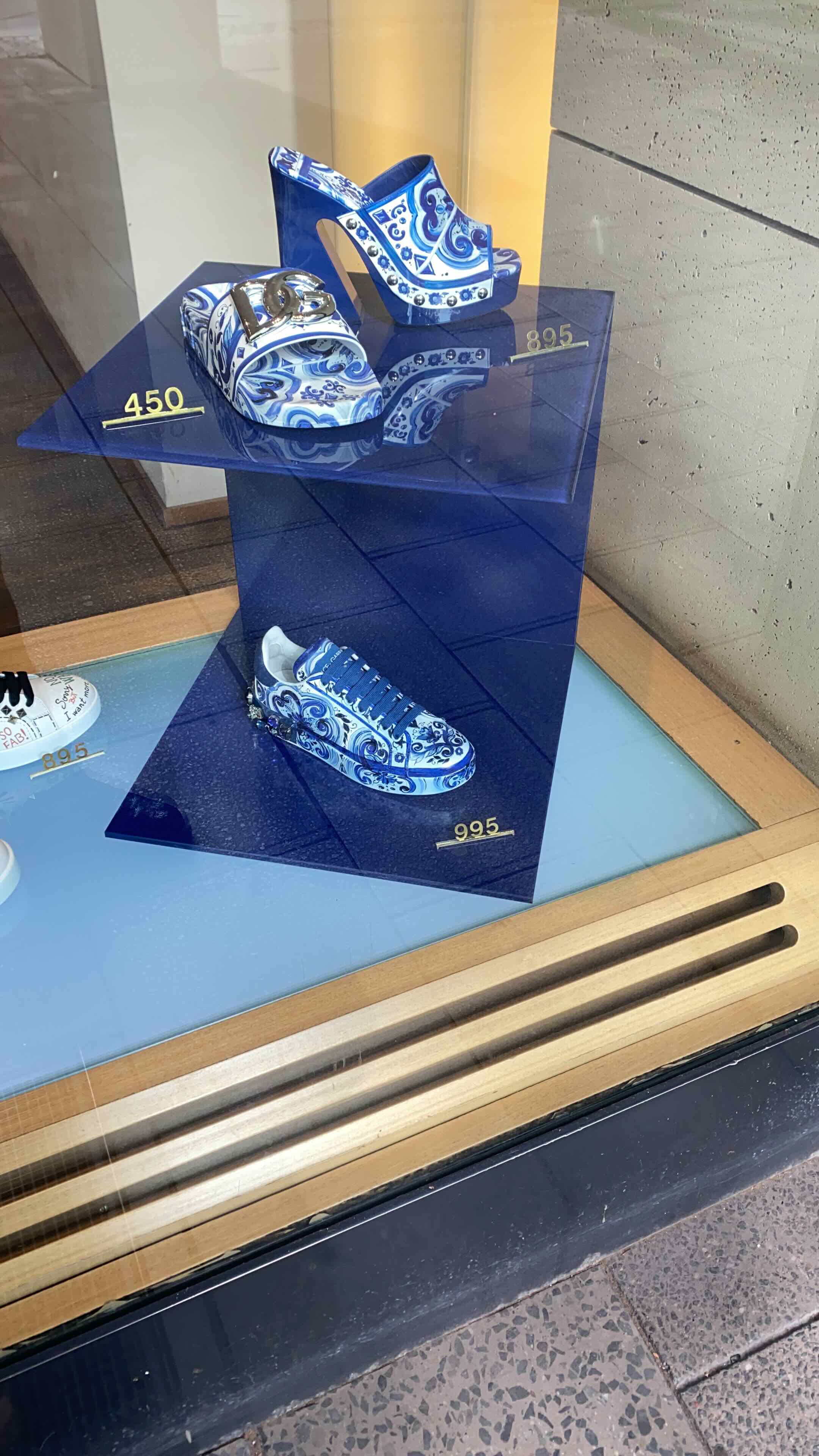
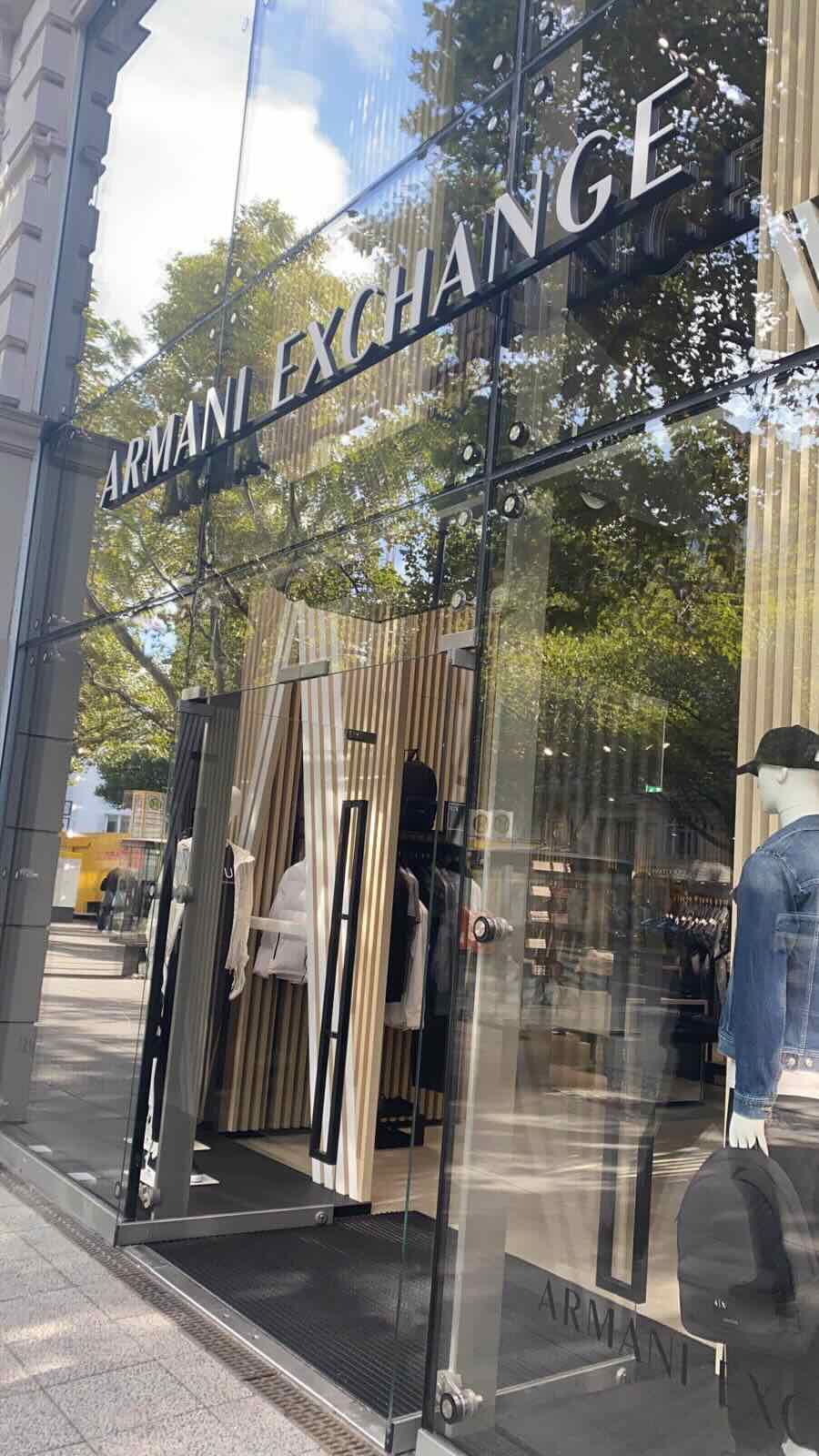
We arrived early at Savignyplatz, and The Man decided it would be a good idea to walk along the Kurfürstendamm, this was centre of West Berlin during the partition era and the main shopping street. Armani, crazy expensive shoes that I didn’t even like. Louis Vuitton, Chanel, Versace, Victoria Beckham, to name a few. Interesting to look at but I wasn’t tempted to buy anything or even try something on. I don’t know if it’s my age but I’m just not bothered about owning any designer stuff. I don’t like bling and it is beyond my comprehension that a minority of people can purchase things in these shops whilst the majority are looking for money to feed the family and keep them warm. I mean €995 for a pair of trainers?!?! But, as I said, it was interesting to walk along the street and a few of the security guards outside shop doors were quite attractive. . . ha ha ha. We sat outside an upmarket coffee shop to take an Americano with hot milk on the side (The Man) and a small cappuccino (me) and had fun, people watching.
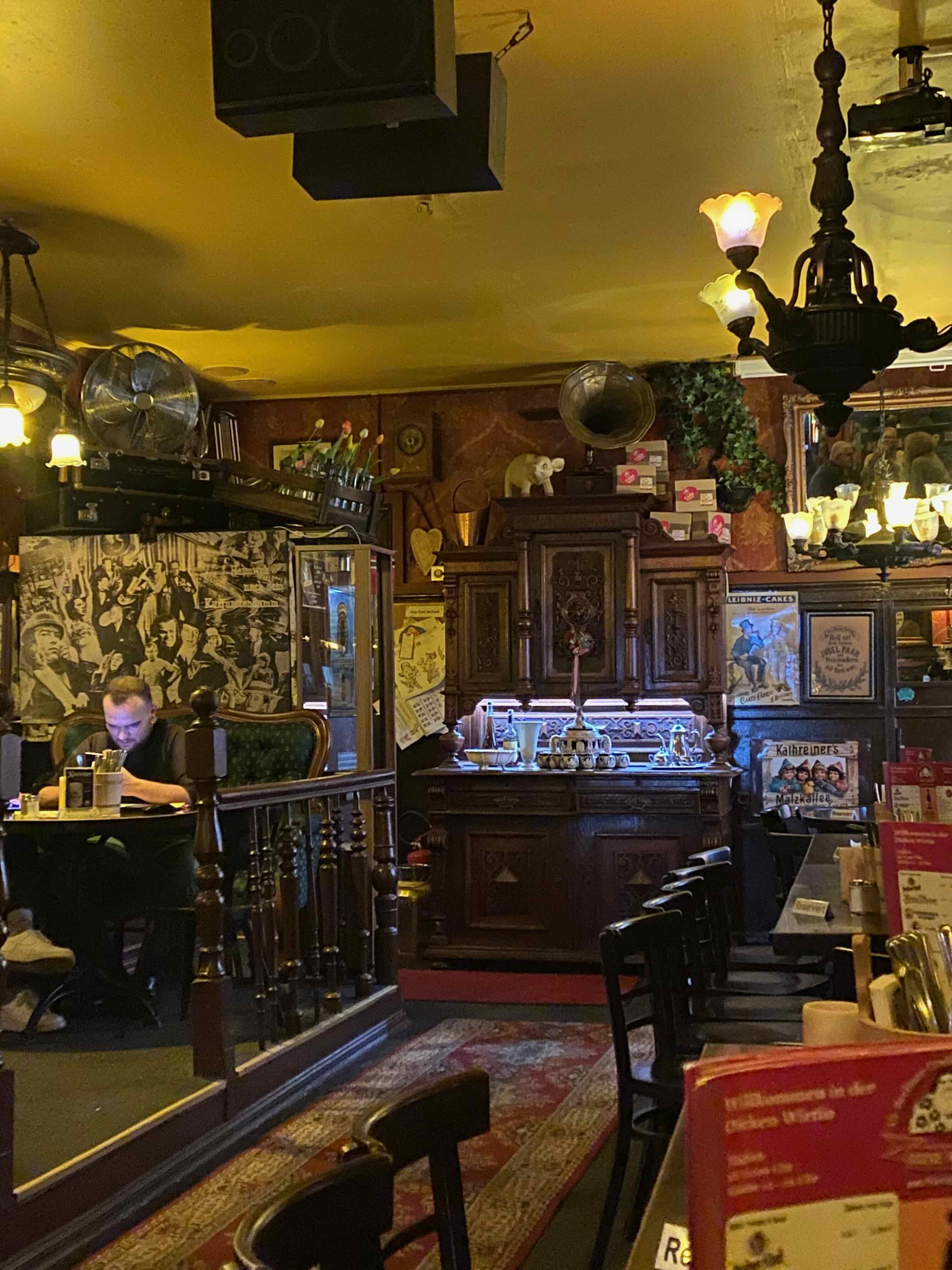
The Dicke Wirtin restaurant was exactly how I thought it would be. In my work in progress, I have my characters dining at Aschingers, which no longer exists, well if it does, I couldn’t find it. However, The Dicke Wirtin (The Fat Landlady) was, I imagine, a close resemblance to Aschingers. What struck me was the amount of dark wood; balustrades divided those dining at tables on the raised platform. High tables with bar stools, and smaller tables with bentwood chairs, or high-backed bench seats with flowery cushions. The place was overloaded with pictures, pottery beer mugs, china cups and trinkets and memorabilia. Some of the walls were papered with a montage of photographs from over the years. The ambience around all this suggested a social history of artists, writers, activists, philosophers and political dissidents, deep in discussion around the tables whilst eating their cabbage soup, bread and cheese or just necking a stein of beer.
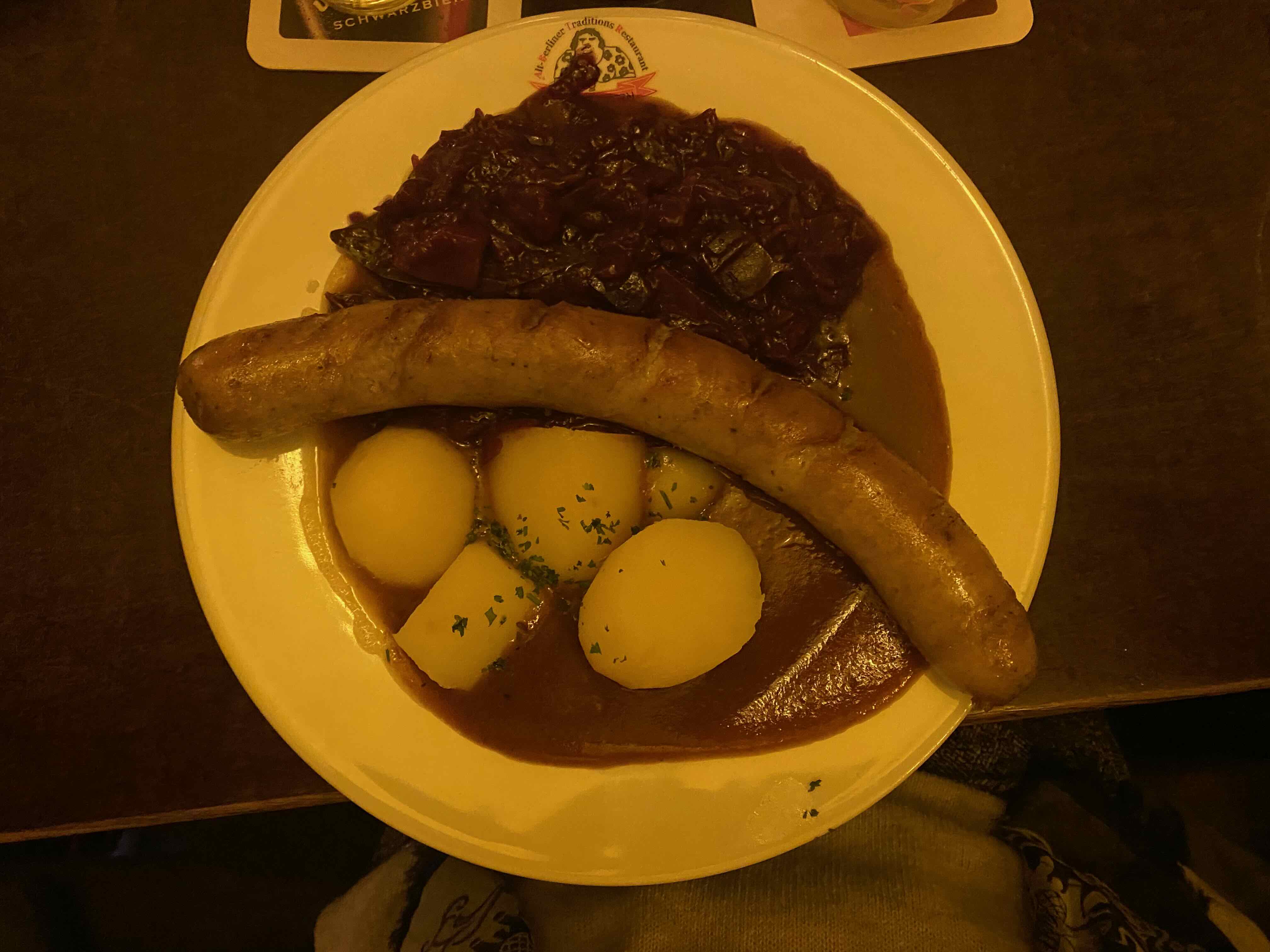
Dicke Wirtin My giant bratwurst The Man’s meatballs
The menu was indeed German. I chose, Riesenbratwurst mit Rotkohl und Petersilienkartoffeln, (giant bratwurst with red cabbage, boiled parsley-potatoes and gravy). It did not disappoint; but I had indigestion all afternoon and well into the evening and the red cabbage had a little too much bay in it for me. Still I don’t ever have to eat it again. The Man chose, Königsberger Klopse mit Rote und Salzkartoffen, (meat balls in a white sauce, beetroot and boiled potatoes). It looked insipid but apparently it tasted fine, Oliva played safe and had the soup of the day. Maybe I should have followed her lead but I really wanted the bratwurst. Perhaps a giant one was a little over the top.
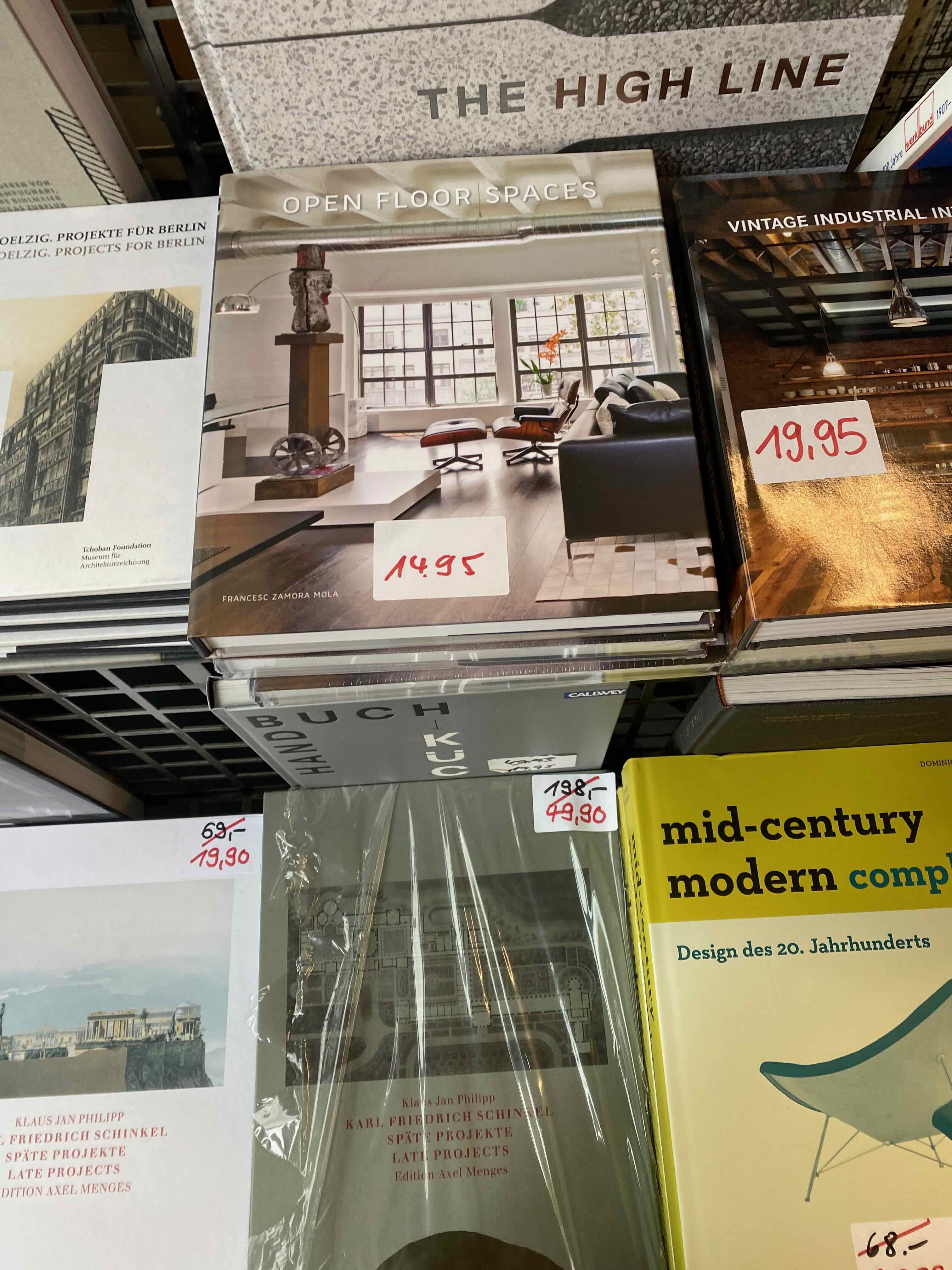
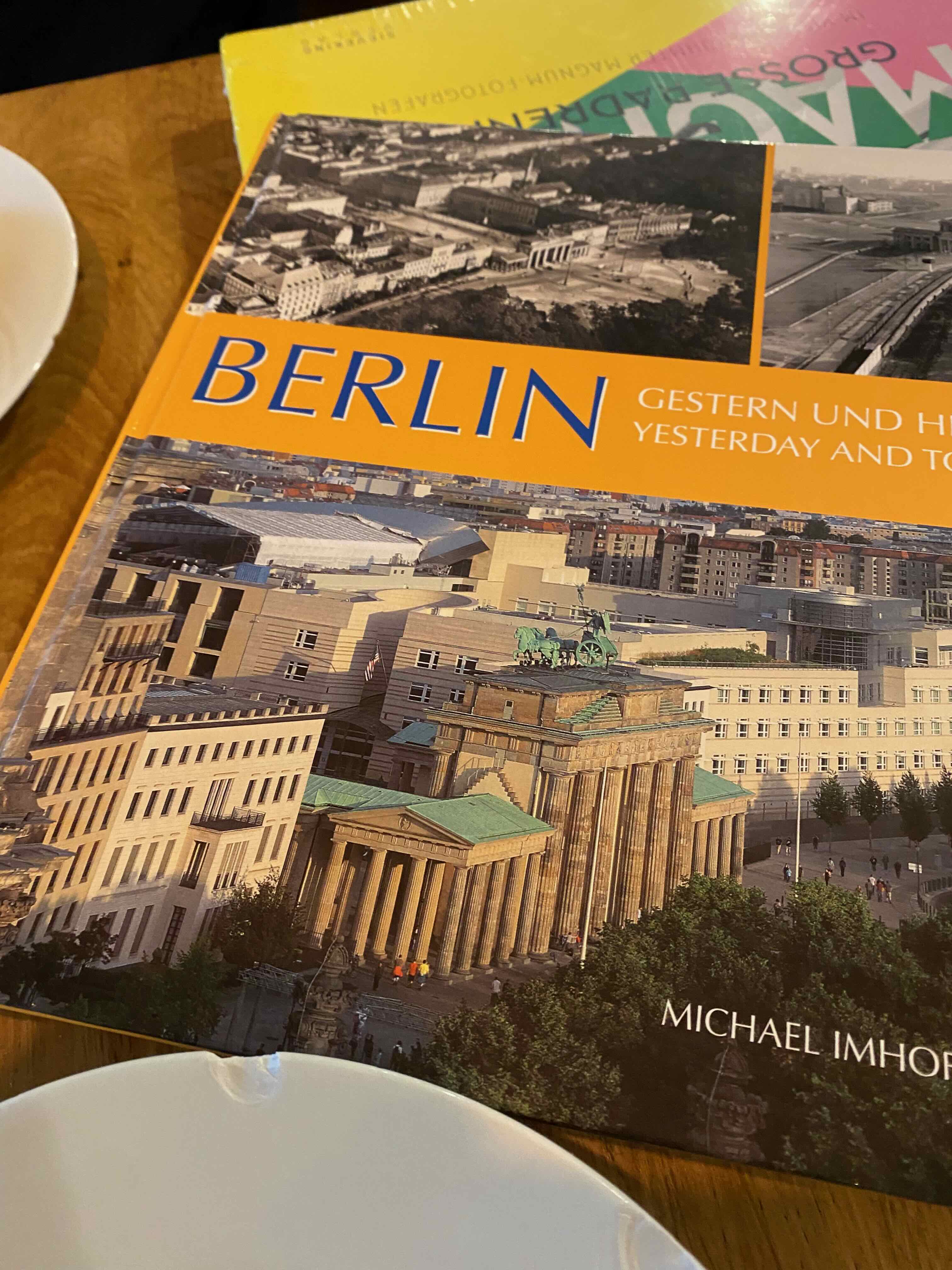
Before we left the area, we visited a huge bookshop under the arches of the railway station. The Man bought a chunky Magnum photographic book with photos of Tours de France over the years. I bought a ‘then and now’ book of photographs of Berlin. Very helpful for my research.
The Man’s BookSome Random BooksMy Book with broken plate
FRIDAY
Big walking day today. Took the S-Bahn from Jannowitzbrücke station (a ten-minute walk from our hotel — have I already told you that? The S-Bahn is above ground and extends beyond the inner city to the suburbs. We were heading for Potsdam. I don’t know if it’s because I was only born five years after the second world war, which meant it was still very much spoken of in my childhood, but the scenery and stations that we passed on our train trip to Potsdam seemed to be full of sights that reminded me of stories that I’d heard. I could imagine people running through the woods looking either foraging for food or looking for a place to hide. I could ‘see’ the trucks and soldiers. It was a little chilling. We stopped at Wannsee station where Hitler, Himmler, Heydrich, Goebbels and others agreed the ‘Final Solution’. The sign for the station was written in Teutonic Script font, also scary. But, moving on, because it was all a very long time ago and I don’t want to dwell on it here, as today’s Germany is not that of the 1930’s and 1940s.
It was Oliva who suggested Potsdam as a must to visit and how right she was. Over the last few years, extensive renovations have taken place. As we walked from the station towards the Sanssouci Palace (the main attraction) we detoured to stroll around the Dutch Quarter of the town. It was easy to identify; the architecture and the bicycles a real giveaway! Loved it, as I did other areas of Potsdam. I think I could easily spend a few months there, in the right sort of apartment with a balcony…hmm wishful thinking, probably far too expensive.
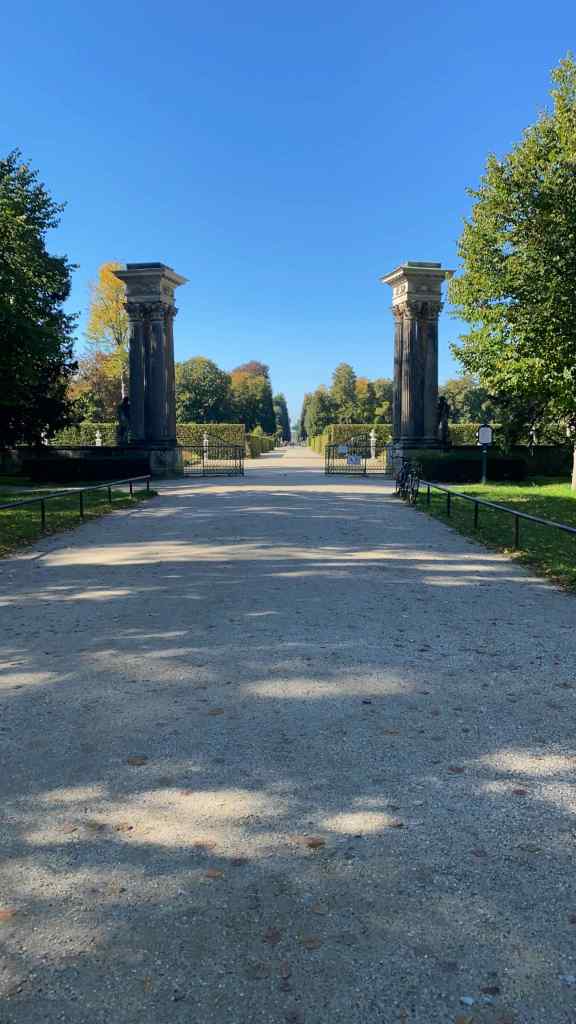
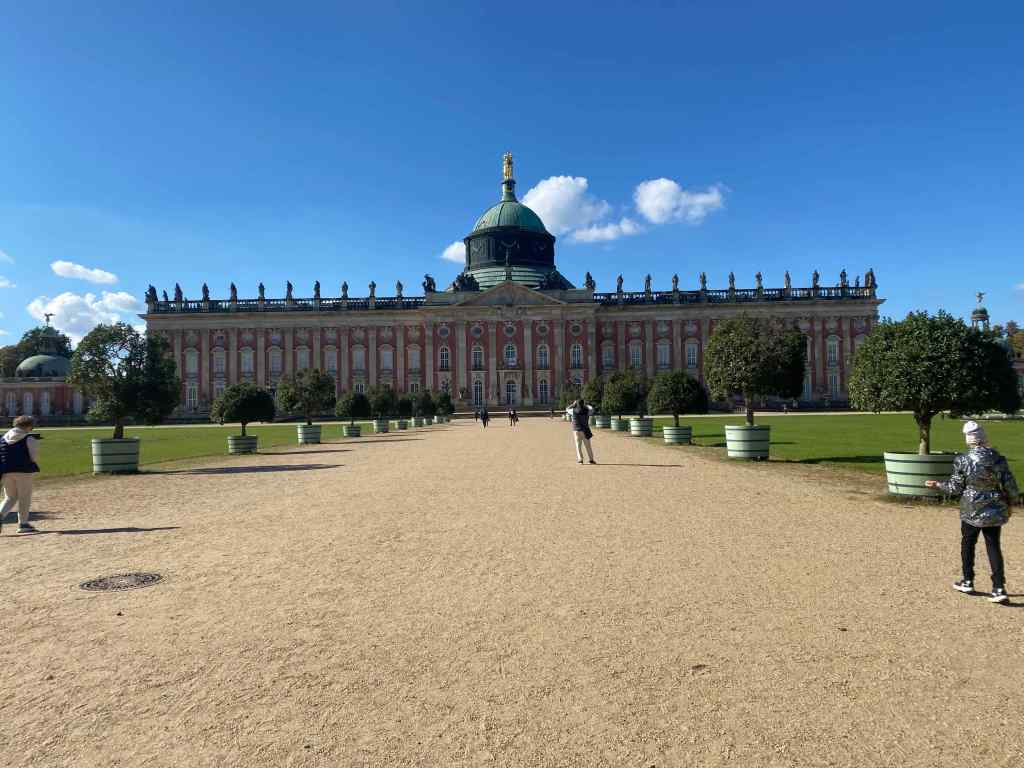
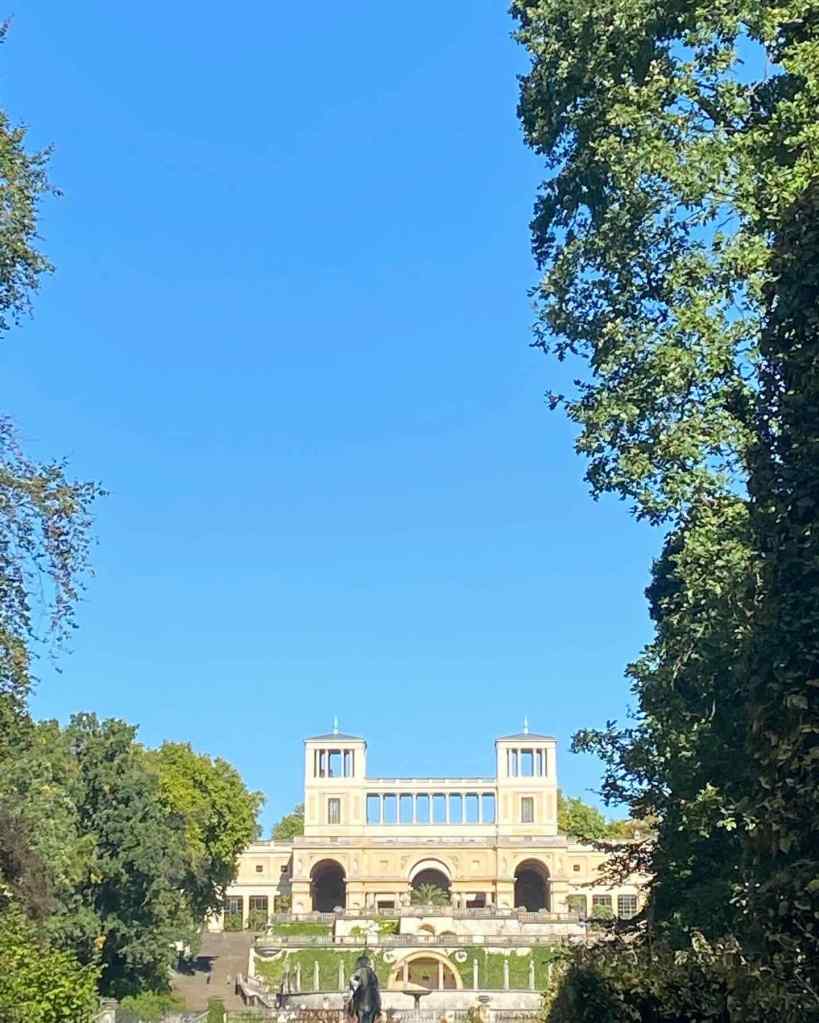
It took well over half-an-hour to walk to the palace gates as we didn’t take the direct route from the station. A sign on the gate said New Palace 1.5k. You could see it in the distance, and it seemed much closer than 1.5k. But. . . it wasn’t, in fact I think it might have been 2k! We walked it anyway. All the way down — and all the way back! Past the Old Sanssouci Palace, the Orangery, the Italian gardens. It was breath taking in its vastness. The grounds extending to many acres and the palace magnificent at the end of its driveway. We didn’t go in. In fact, I’m not sure it was open to the public.
We both loved Potsdam but our legs and feet did not appreciate our enthusiasm. After stopping for a quick ‘bowl dinner’ at Dean and David’s (a great little restaurant chain – it was our second visit) we headed straight back to the hotel and a quiet evening in our room playing cards and after around 12 kms, resting our tired limbs.
Entrance to Sanssouci Palaces, Old and New
New Sanssouci Palace
Old Sanssouci Palace (The Orangery)
The Italian Garden
Dutch Quarter
Potsdam
Potsdam Street
Another Potsdam Street
And another
Alten Markt, Potsdam
SATURDAY
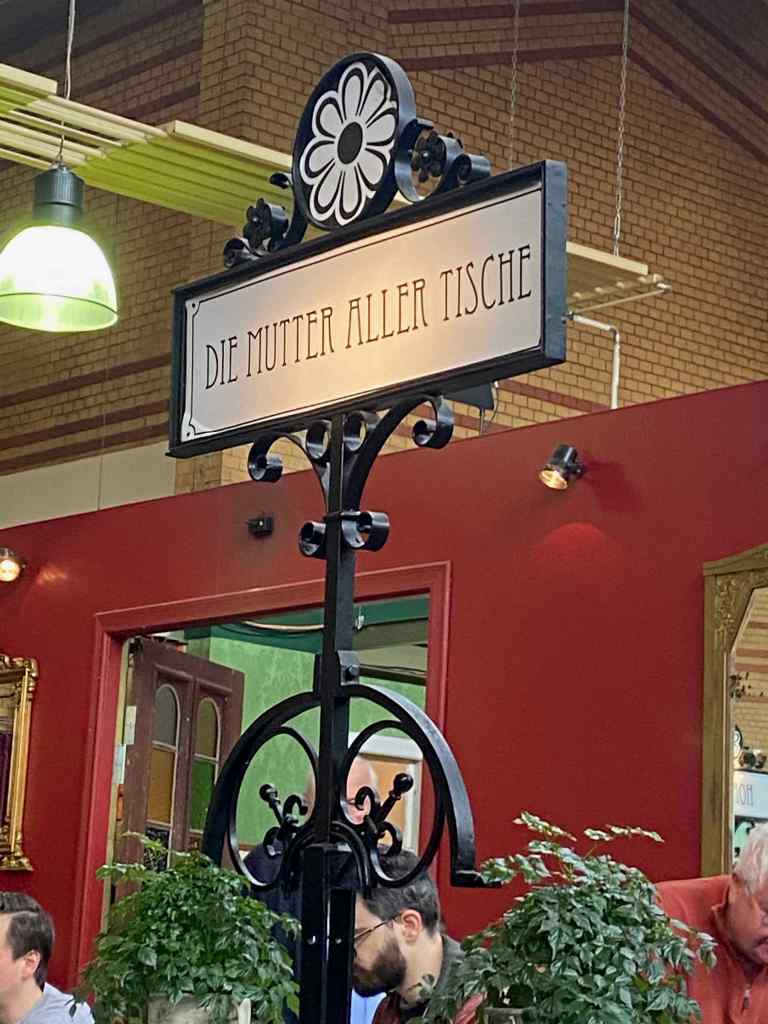
The forecast for Saturday wasn’t good, rainy and dull. The Man had a desire to visit the Arminius indoor market in Moabit, where we thought we might pick up brunch. As you might expect it was a very large, brick, purpose built, market hall with high ceilings and glass windows around the top of the walls. The smell when we walked in teased the taste buds; frying bacon, waffles with syrup, coffee etc., We opted for the all you can eat brunch. We paid €37 each and were given a wrist band to prove it. The menu included unlimited Prosecco (which we didn’t have because neither of us drink alcohol). The friendly waiter showed us to a table and immediately brought us a huge pot of coffee. All you had to do was visit any one of a number of stalls selling different breakfast food, fill your plates, return to your table and eat. You could do this as many times as you liked from 10am until 2pm. Needless to say, we didn’t pace ourselves very well, and only managed about an hour and a half of eating. All this scoffing was accompanied by a piano player! Also, there was a very large table for friends and family to gather around. It has a sign above it saying Die Mutter aller Tische, The Mother of all Tables.
The Market
Inside the market – seating and bars
The mother of all tables…
De Mutter Aller Tiche (the mother of all tables)
Waiter serving endless glasses of Prosecco
My waffles…
Beer Tanks Over the Bar
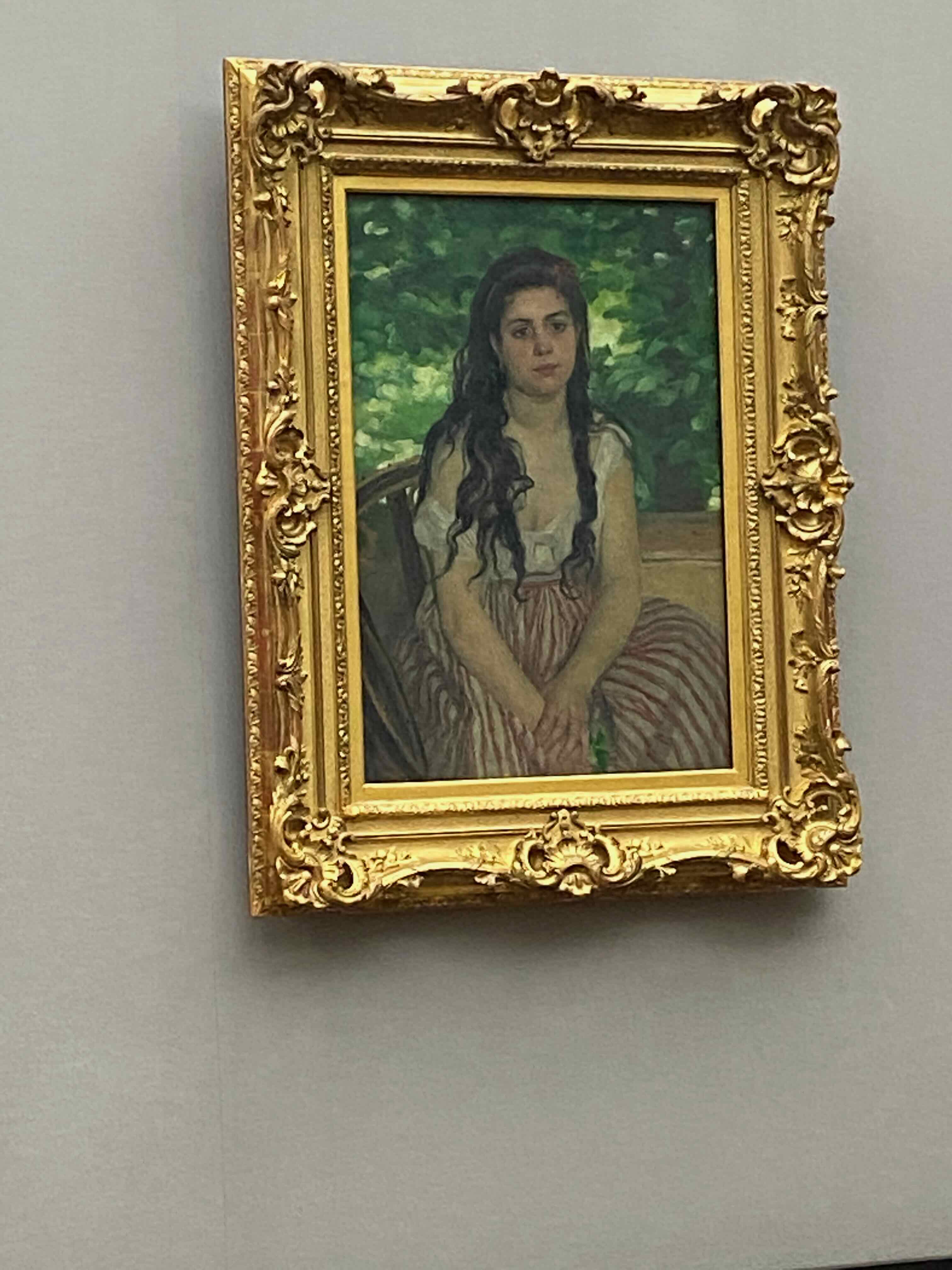
The rain was rather heavy by the time we left. We took the train back to Alexanderplatz and went to the Alte Nationalgalerie, a magnificent building. We wandered around and looked at many paintings — which is what you do in an art gallery — a favourite of mine was a Renoir called In Summer. It’s of a young girl sitting in the garden looking pensive. I was inspired to write a story from it. Sounds a bit trite but I felt she spoke to me.
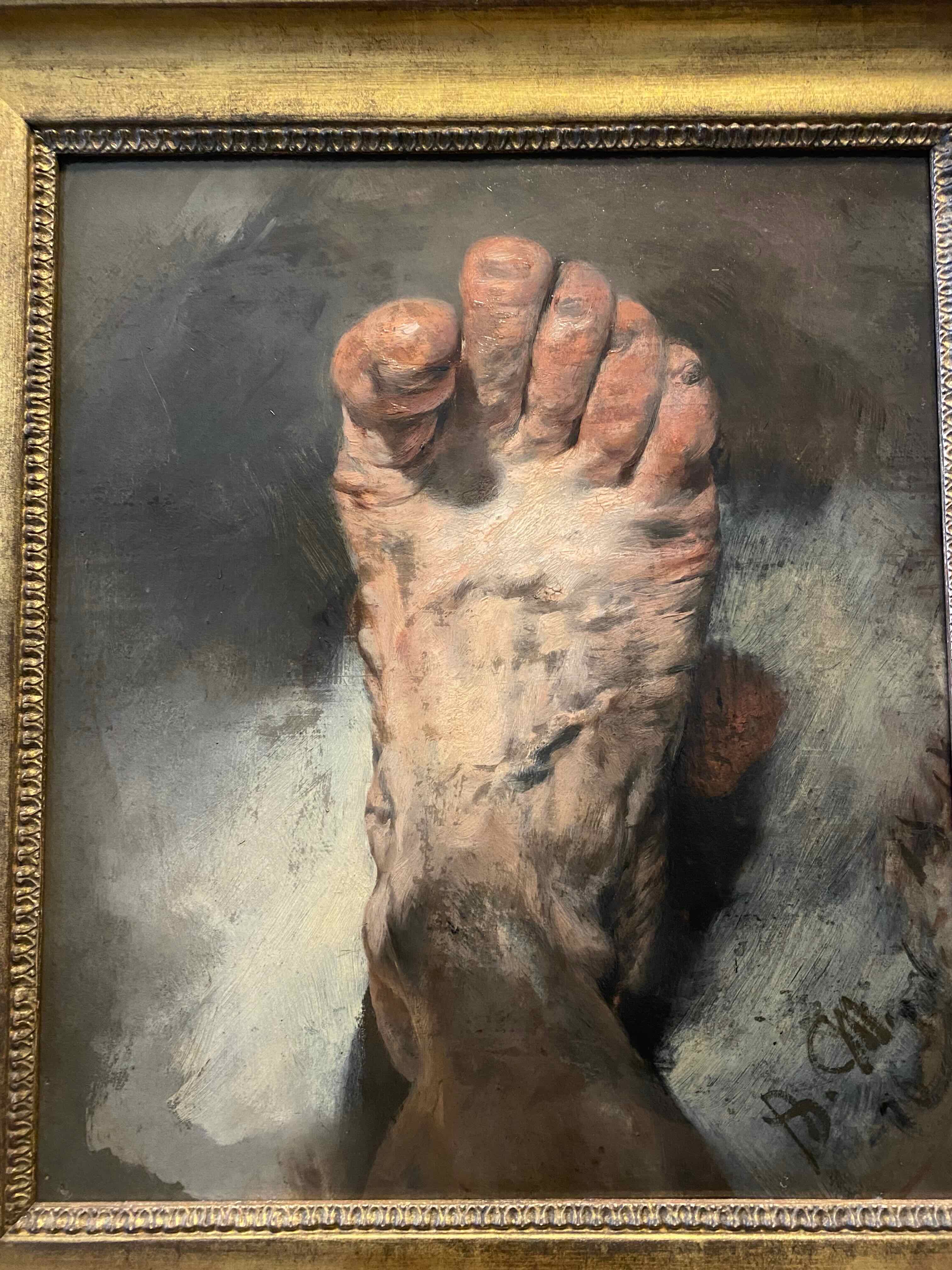
Another painting that has stuck in my mind is The Foot of The Artist, by realist artist Adolf Menzel. I couldn’t stop staring at it. As yet though, it has not inspired a story.
The Alte NationalegalleryView from first floor of the Museum My favourite paintingThis is the foot…The Man’s favourite
The Man is fond of sculpture, me not so much, but I’ve included a photograph above of his particular favourite from the day, a stevedore from Wilhelmshaven.
We loved Berlin and I look forward to visiting again. There’s so much to see and do and it’s a wonderful city. If you haven’t visited yet I can highly recommend that you do so as soon as possible!.
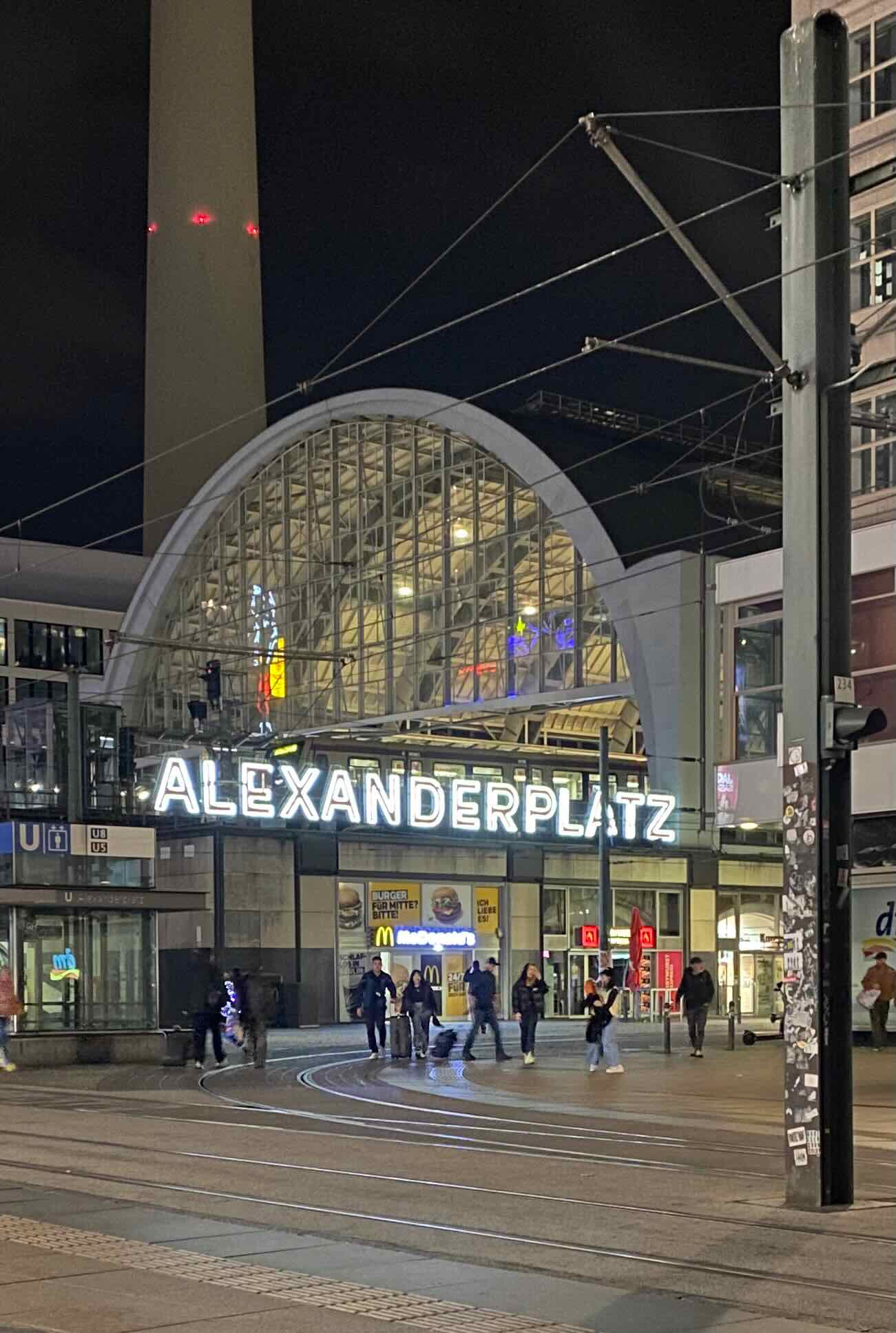
We flew from Bristol to Berlin on Sunday 25th September and after dropping our bags at the hotel and having a bite to eat we took a short walk to Alexander Platz, which is when we discovered that the Berlin Marathon had been run earlier in the day. There were lots of road blocks and barriers erected everywhere, and a great many tired looking people filling the restaurants — and their stomachs — sporting finishers medallions around their necks.
I immediately loved the vibrant atmosphere in the famous Alexanderplatz. Young people milling around or sitting in groups drinking and eating. The pervading smell of doughnuts, fried onions, and other street food assailed my nose. It was exciting. Equally delightful were the backstreet areas and their small squares with trees.
Television TowerStation Back Street
Below is the Neptune Fountain to be found in the gardens behind Alexander Platz. It was originally situated outside the City Hall in the Palace Square.
Continue reading to see where and what The Man and I got up to on Monday, Tuesday and Wednesday:
Monday:
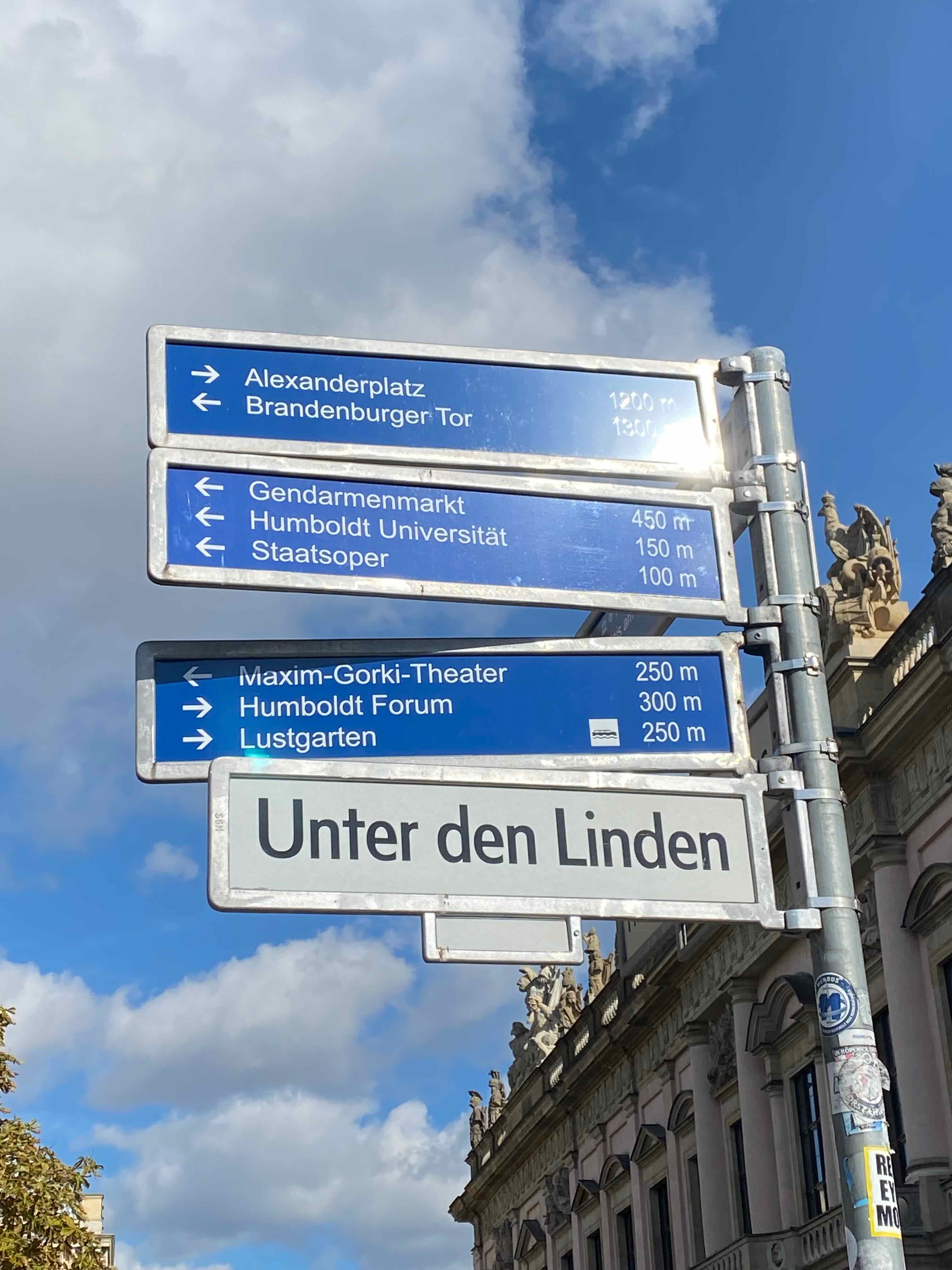
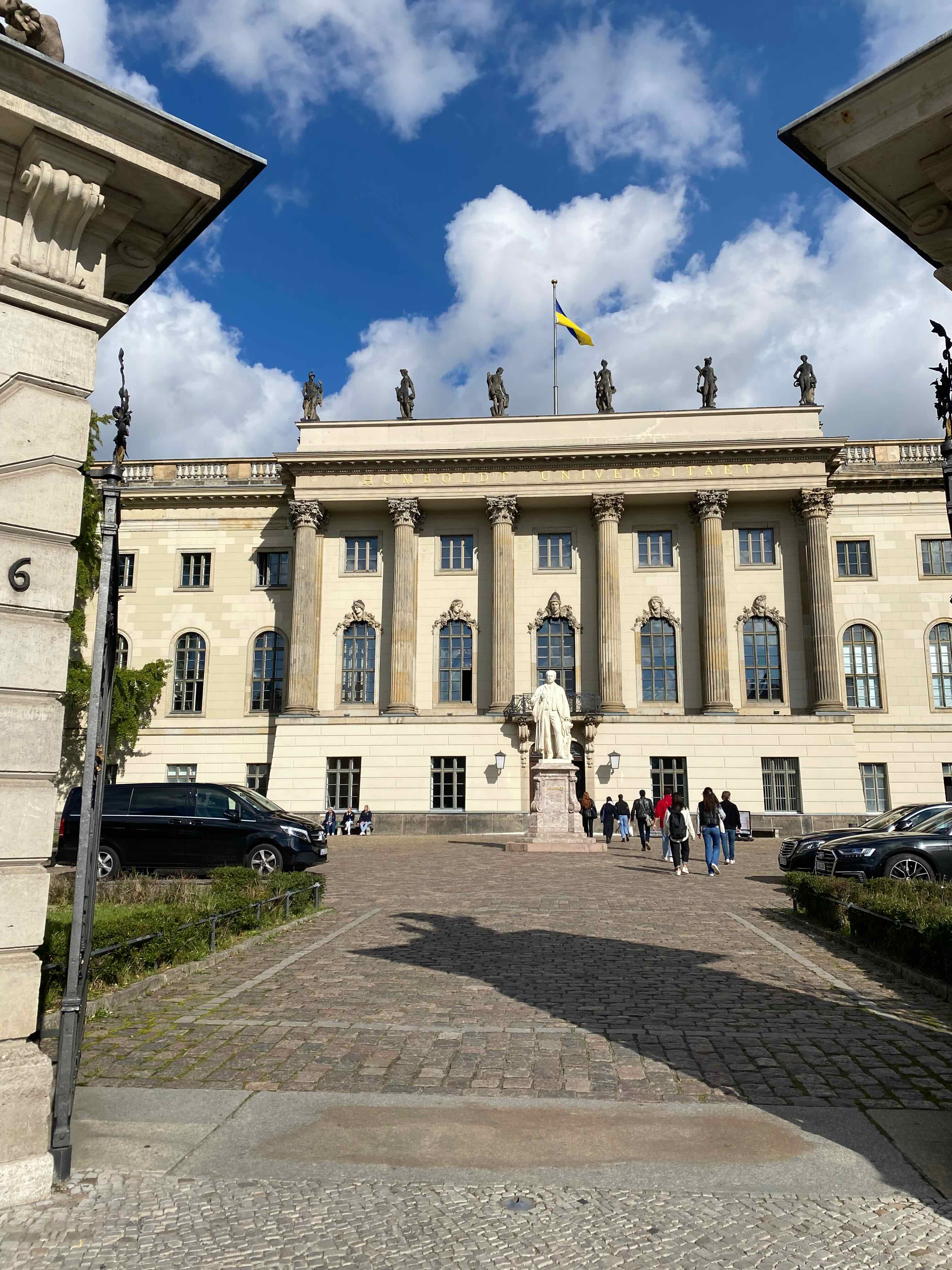
We walked from our hotel in Mitte, to Unter den Linden, past the Humboldt University, up to the Brandenburg Gate. I wanted to have coffee in the famous Adlon Hotel but it was closed to non-residents. However, they did own a little coffee shop right next to the hotel so we went in there to have our breakfast. We were in Berlin for me to do some research but also as tourists because neither of us had ever been to the city.
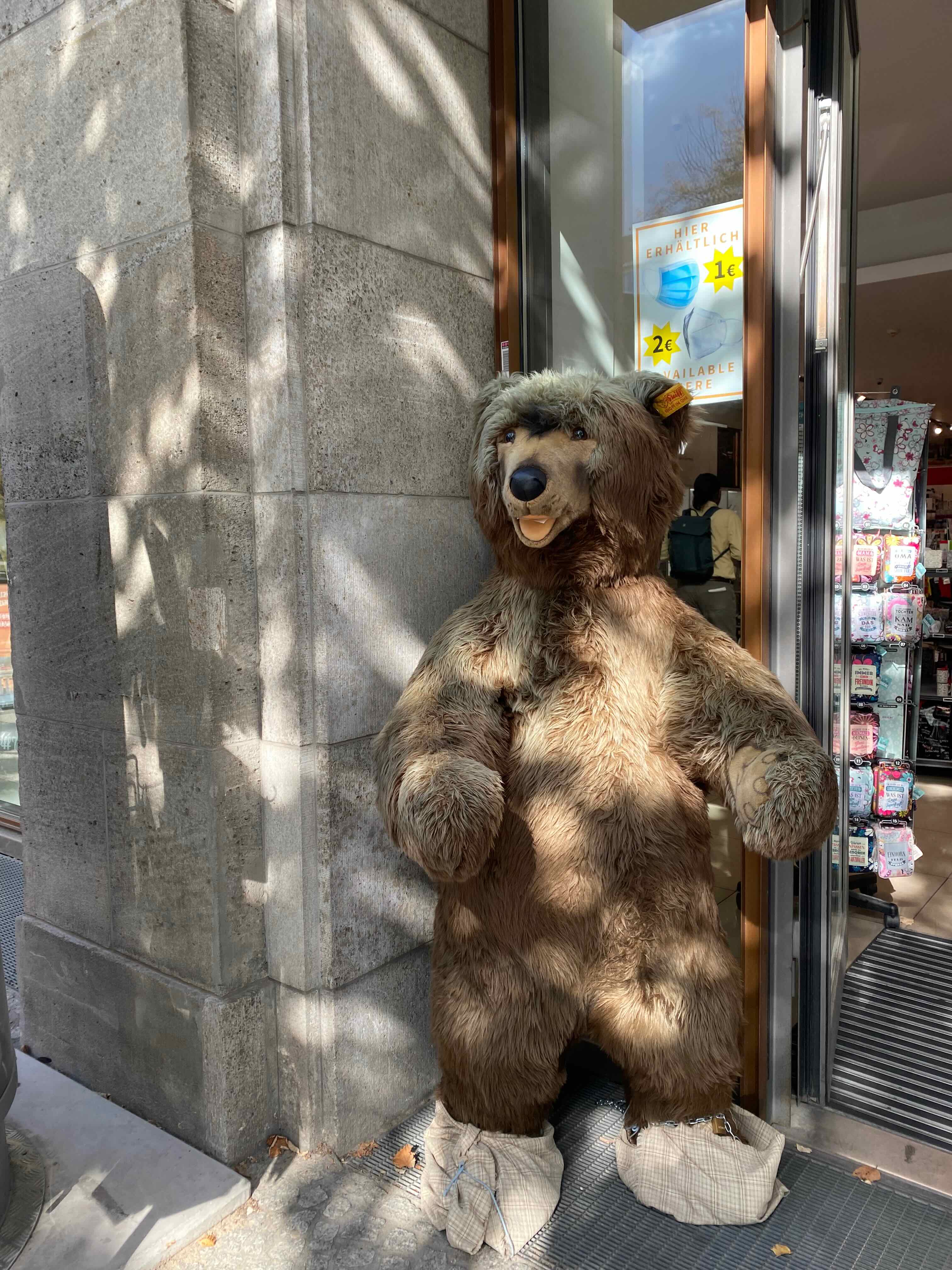
Signpost (obvs!)Me on Unter Den Linden Brandenburg Gate Part of the Humboldt University Breakfast The Adlon Hotel The Man and I in front of The Brandenburg Gate The Bear: the symbol of BerlinThis man was not going to let us through the road block even though we were on foot
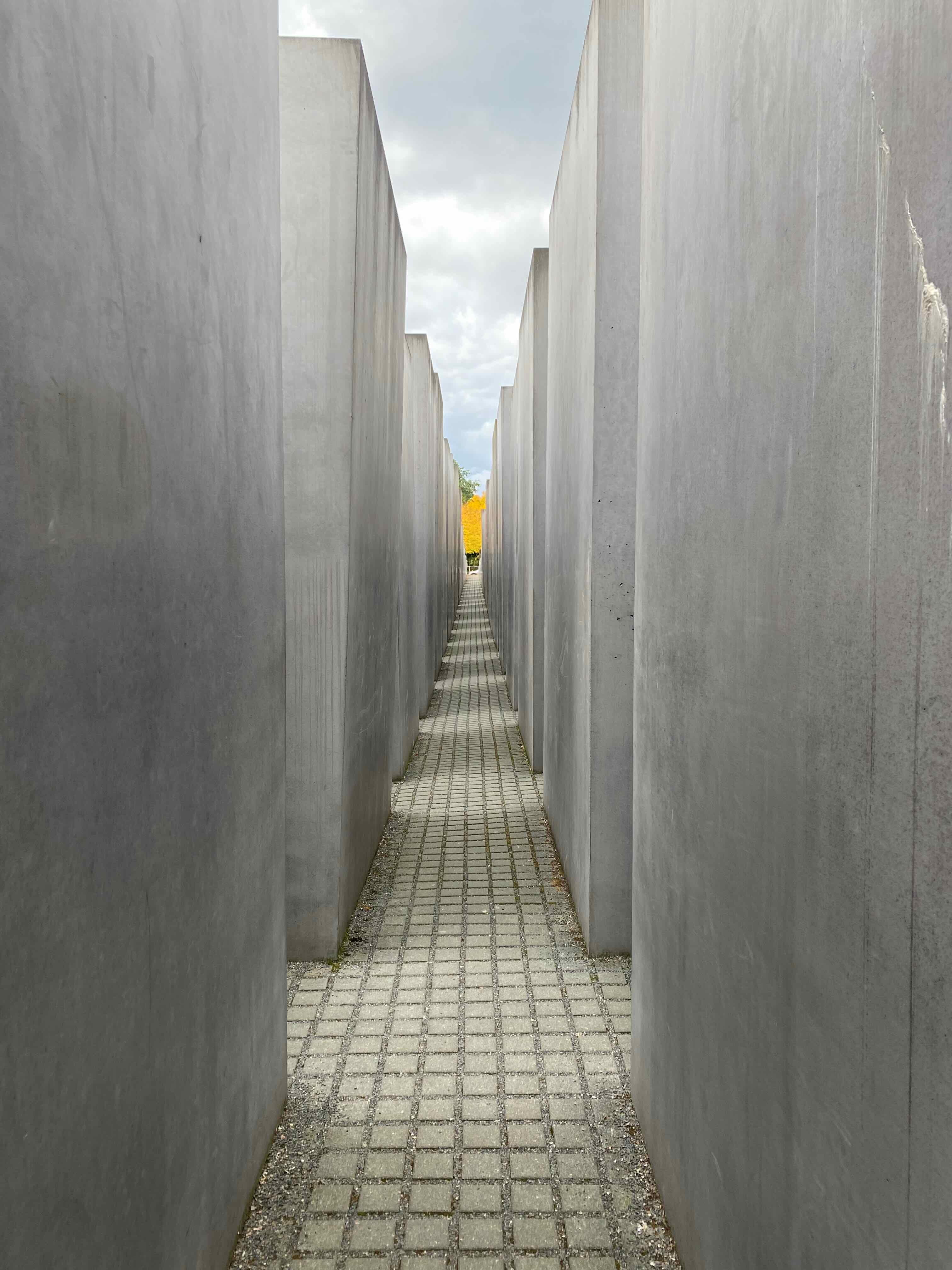
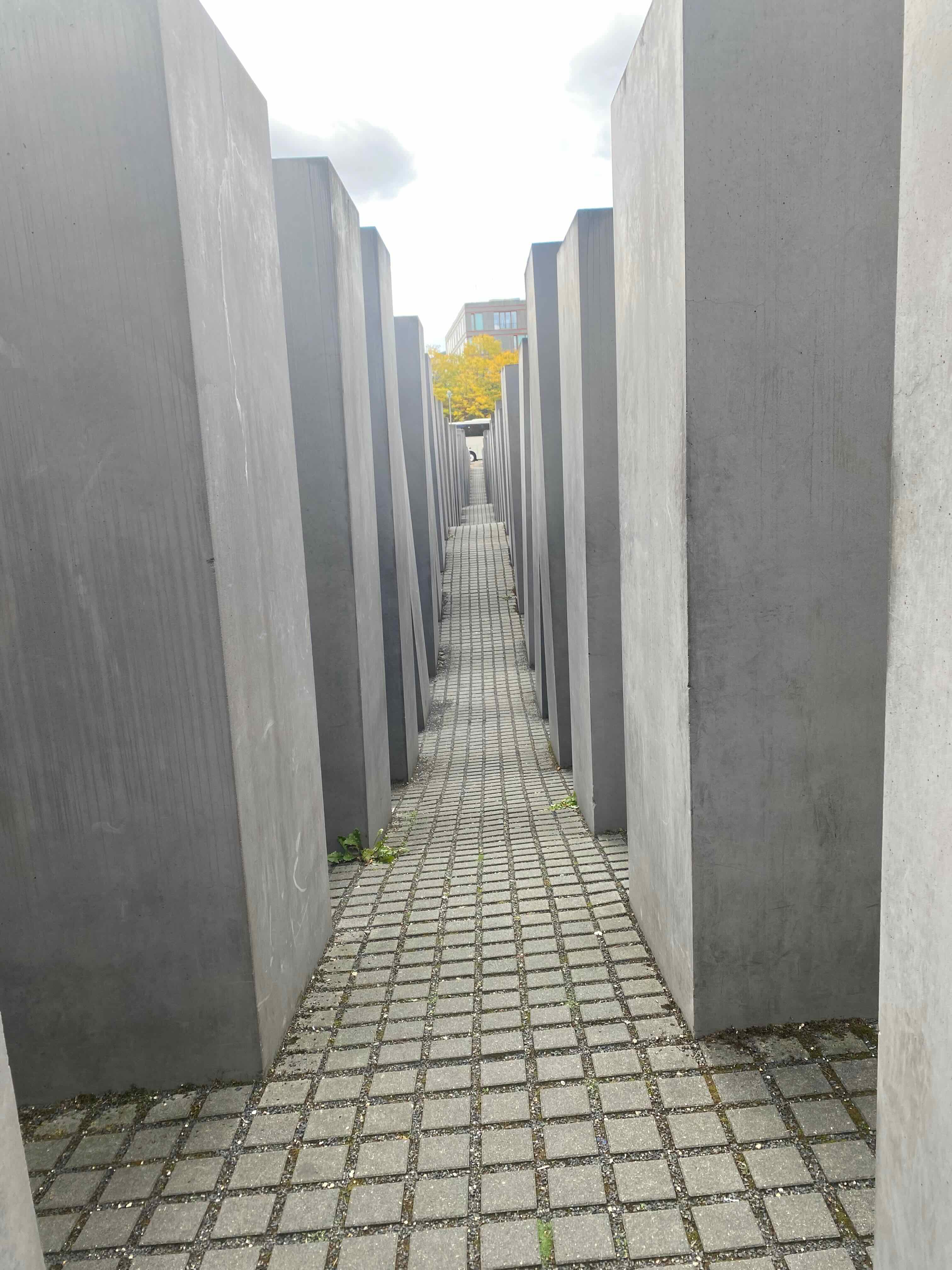
After our breakfast we walked to the Holocaust Memorial. A unique memorial which, in it’s simple complexity (if that makes sense) took me to a strange and thoughtful place where I spent a few moments to contemplate the horror and pointlessness of war, the loss of so many lives and. . . the human race never learns — at least our leaders do not.
From the memorial we made our way through the Tiergarten which was much bigger than I ever imagined and we only walked through a tiny part of it.
Tuesday:
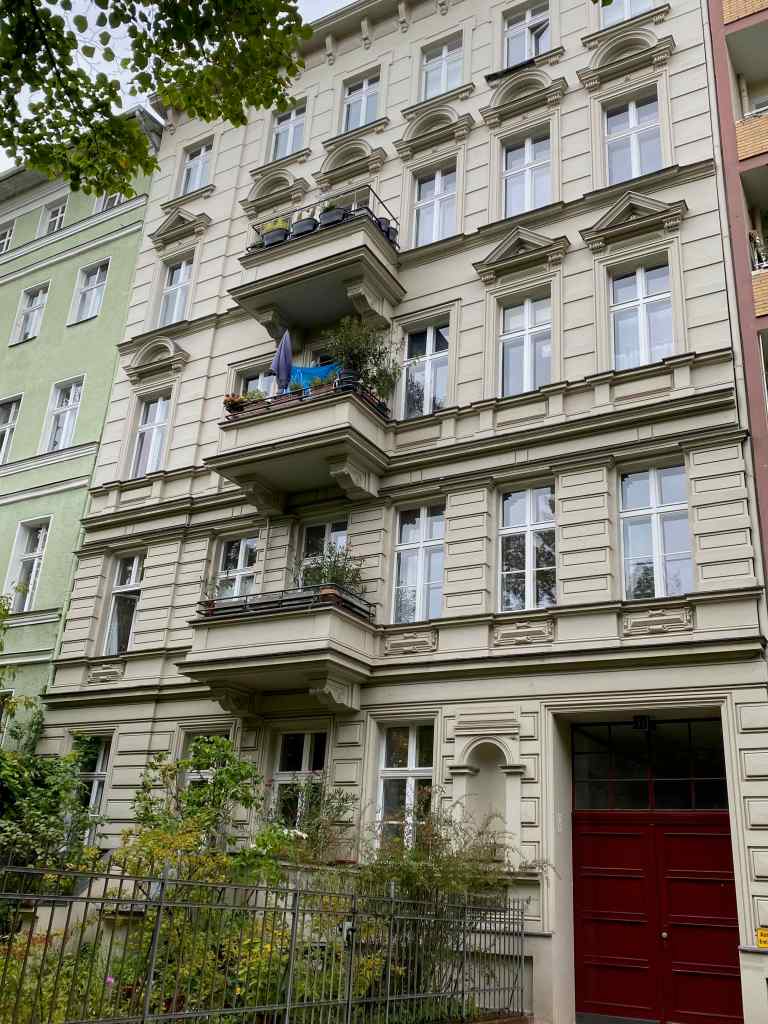
We ventured to Charlottenburg, an area I was particularly interested in for my research. Our first time on the U-Bahn. The payment system was a little unnerving but actually, once we got the hang of it, very easy. Once you have bought a ticket, either for a single trip or another option such as a twenty-four hour ticket for A, AB or ABC zones, then you validate it and that’s it! No barriers to wait at, no queuing behind someone who’s app won’t work, or their ticket doesn’t scan… it’s not at all stressful. We didn’t get lost once. We walked from the Sophie-Charlotte-Platz station to the Charlottenburg Palace, passing through a fairly affluent residential area, with wide tree lined streets, big houses or apartments. The architecture dating from 19th and early 20th century, some of which managed to survive the WW2 bombing of Berlin.
The palace, both the old and the ‘new’ extension, was interesting and historical. I often don’t bother with the audio guide but we did this time and I would highly recommend using them. It didn’t cost any extra, but enhanced my tour of the palace by explaining the functions of the rooms, the paintings, furniture and history of the place. So much more enjoyable than just wandering through the rooms randomly and reading a few information labels on the walls. One of my favourite rooms was the Gold Ballroom — it took all my restraint not to waltz down the room (in fact I did do a little turn or two 😊). Peruse the photographs in the slide show from the U-bahn to gardens of the palace.
GB on the U-Bahn
One of the station stops on the U-Bahn (just liked it)
Apartments
More Apartments
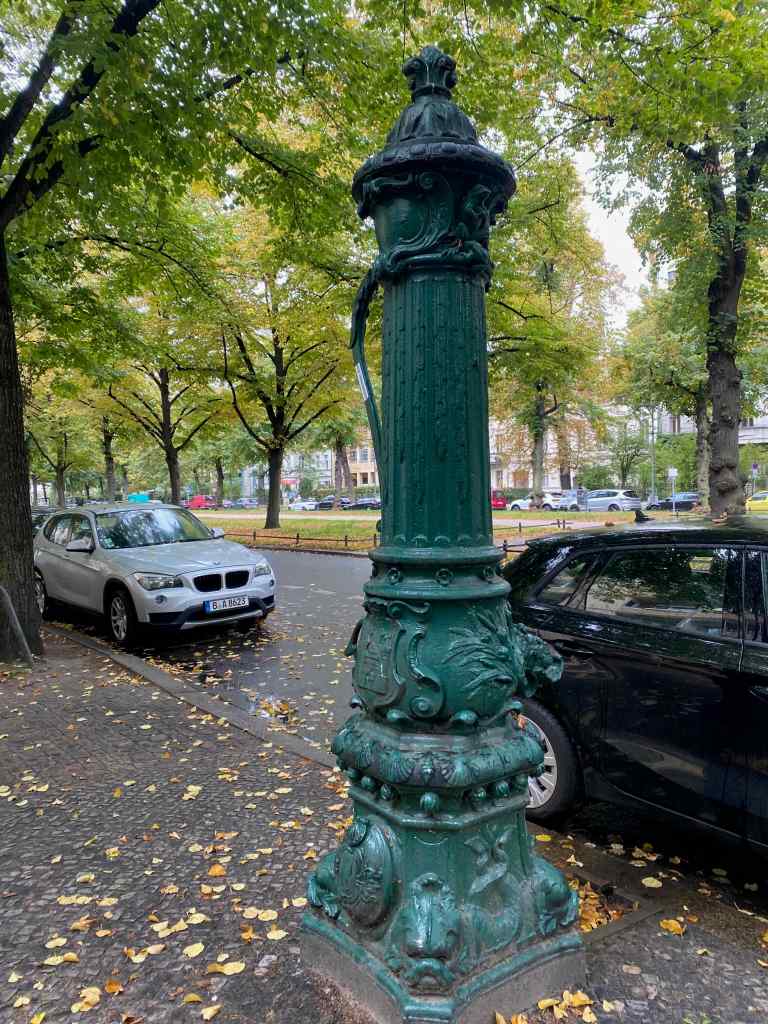
An old pump…
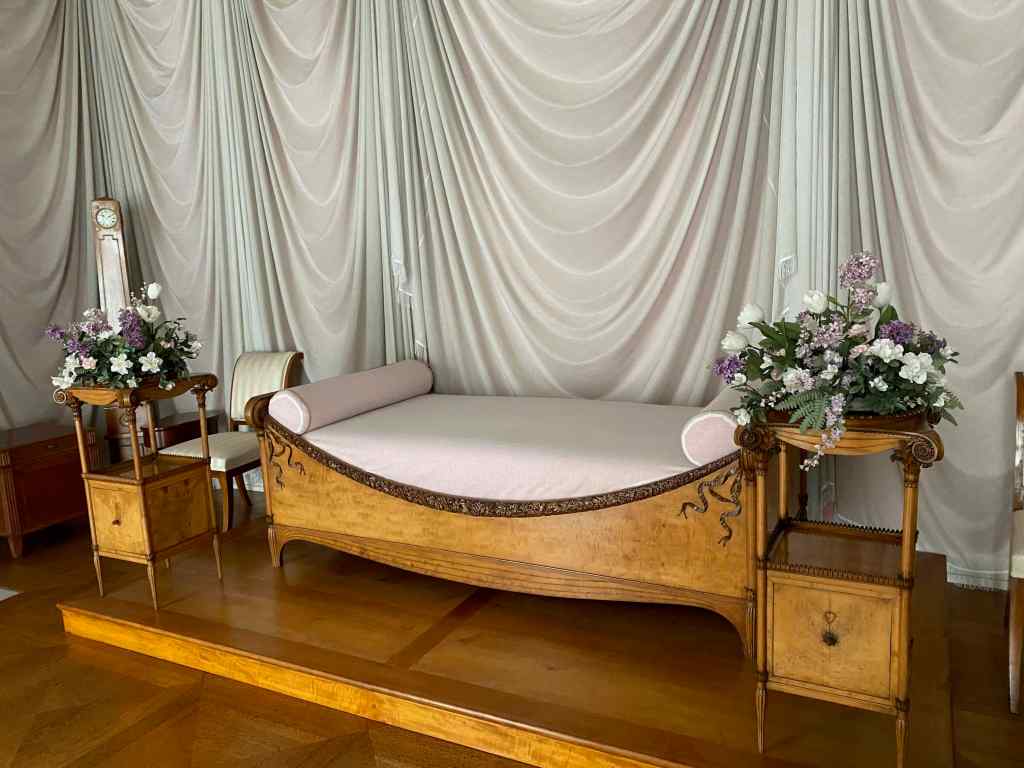
Some princess’s bed…
The Gold Ballroom…not the best shot but they had scaffolding on one side so couldn’t do a central one.
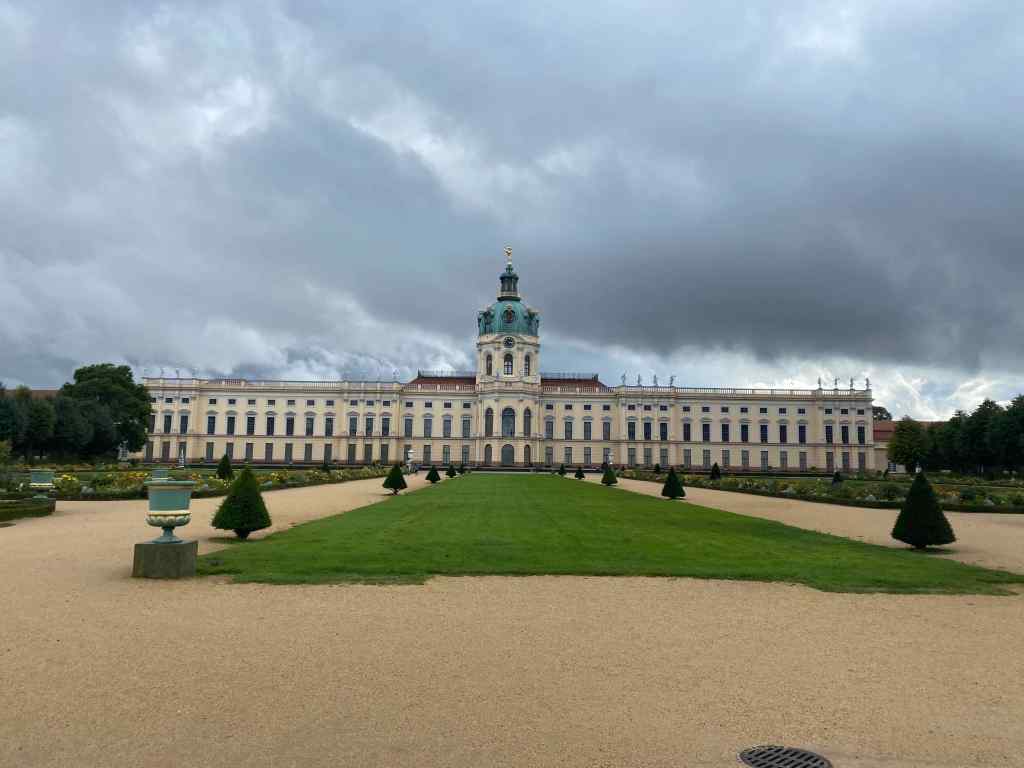
Charlottenburg Palace (the old one) New Wing is to the left out of sight but it was about the same size.
A taste of the garden
Nice flower in a pot
Wednesday Morning
Not far from our hotel (less than a ten minute walk) was the Märkisches Museum. It opened in1908 after several years of construction. The museum today shows the social and political history of Berlin. It is one of the best museums I have ever visited. Once again I used the audio guide enabling me to gain so much more from the exhibits.
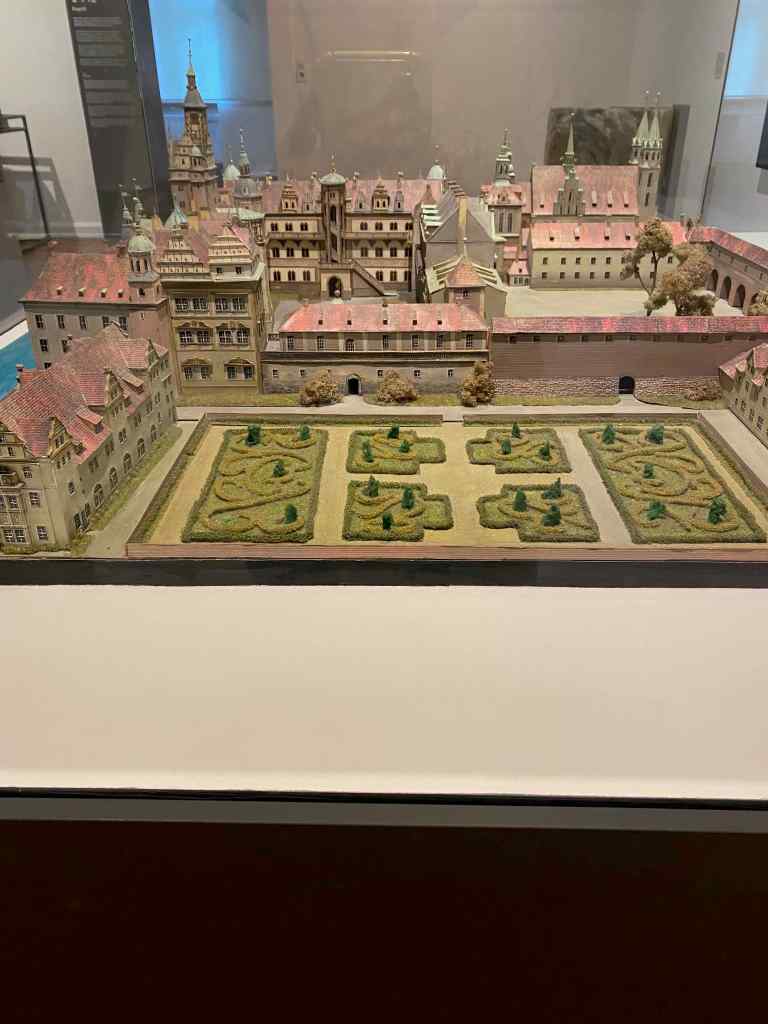
We walked through the rooms which were arranged in chronological order beginning around the 12th Century right up to the the 1970s. There was so much to see in each era, including Berlin’s collision with the plague, a model of Berlin in the 15th Century, and a big scale model of Berlin from the 1700s where one could see the city wall around the edge and The Man and I could just about pick out where our hotel was now standing. The rise of Prussian militarism, three internal wars, culminating in German unification. History of WW1, the post war economic collapse, and Hitler’s rise to power. WW2 and on into more recent times.
We had fun with the jukebox and I had fun in the barber’s shop — I took my research seriously, honestly!
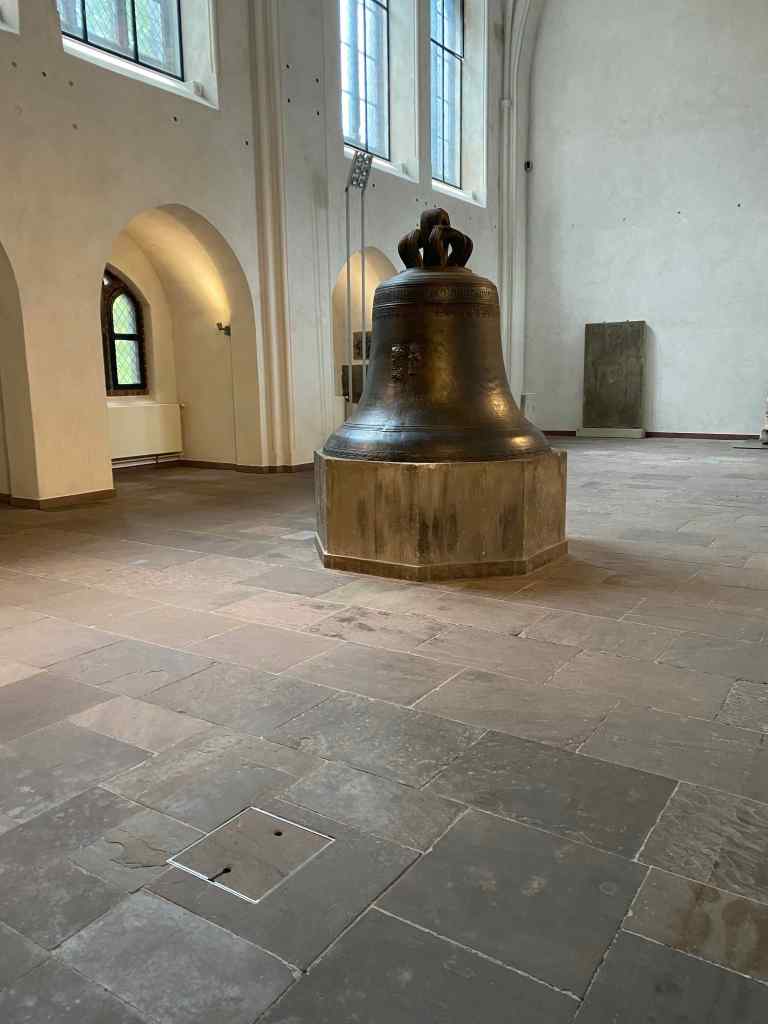
The Old Bell to be found in the first gallery. Originating from the Berliner Dom.
A model of an imagined Berlin from the 15th Century.
The large model of Berlin in the 1700s
Me listening to the juke box
Kaiser Ninhelm
Wednesday Afternoon – The Wall
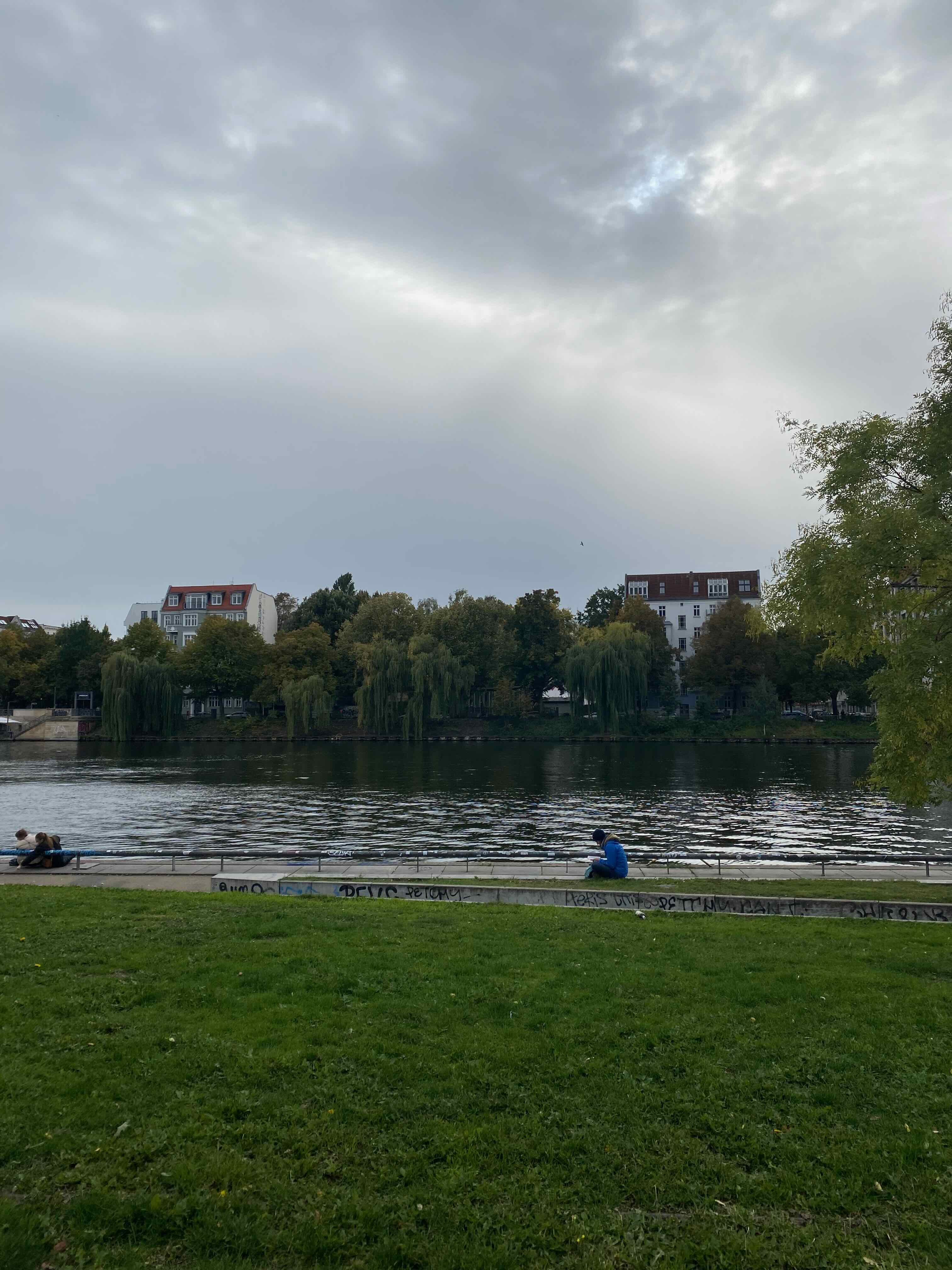
I was ten when the Berlin Wall went up and I couldn’t get my head around it all. I remember asking my dad why they didn’t just walk around the edge. . . I think he must have thought me too young to need an explanation. From the Märkisches Museum, we crossed the river and walked the 2.5km alongside the River Spree heading to the East Side Gallery. After walking for more than a kilometre we found ourselves beside a long stretch of the original wall. I wasn’t sure if the wall was in its original position or not, because it’s hard to follow the route today not knowing whether you are, in what was East or West Berlin. Fortunately for me, I happened across a young girl in a kiosk carrying a clip board and folder. She was part of a volunteer organisation who work to preserve this section of The Wall for posterity. She explained that ‘Yes, this was the original position of the wall’. There was 1.4 kilometres of it and we were at the end. She showed me a photograph from the 1960s and pointed to a building, ‘See that building, it still stands there, and houses The Wall Museum.’
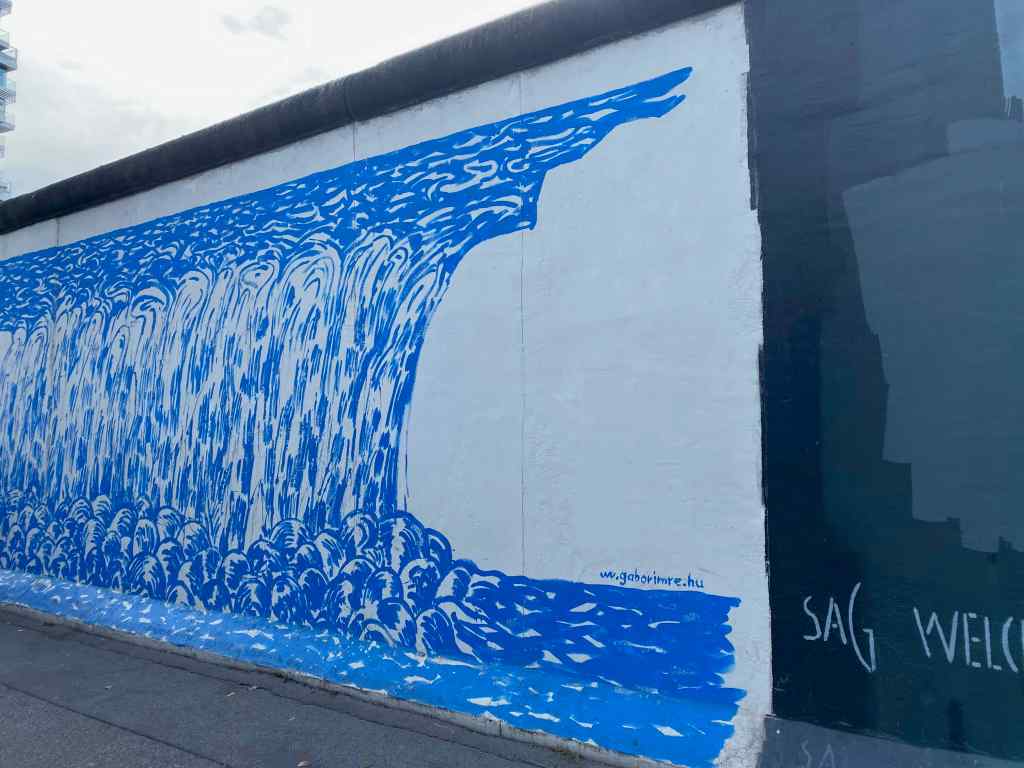
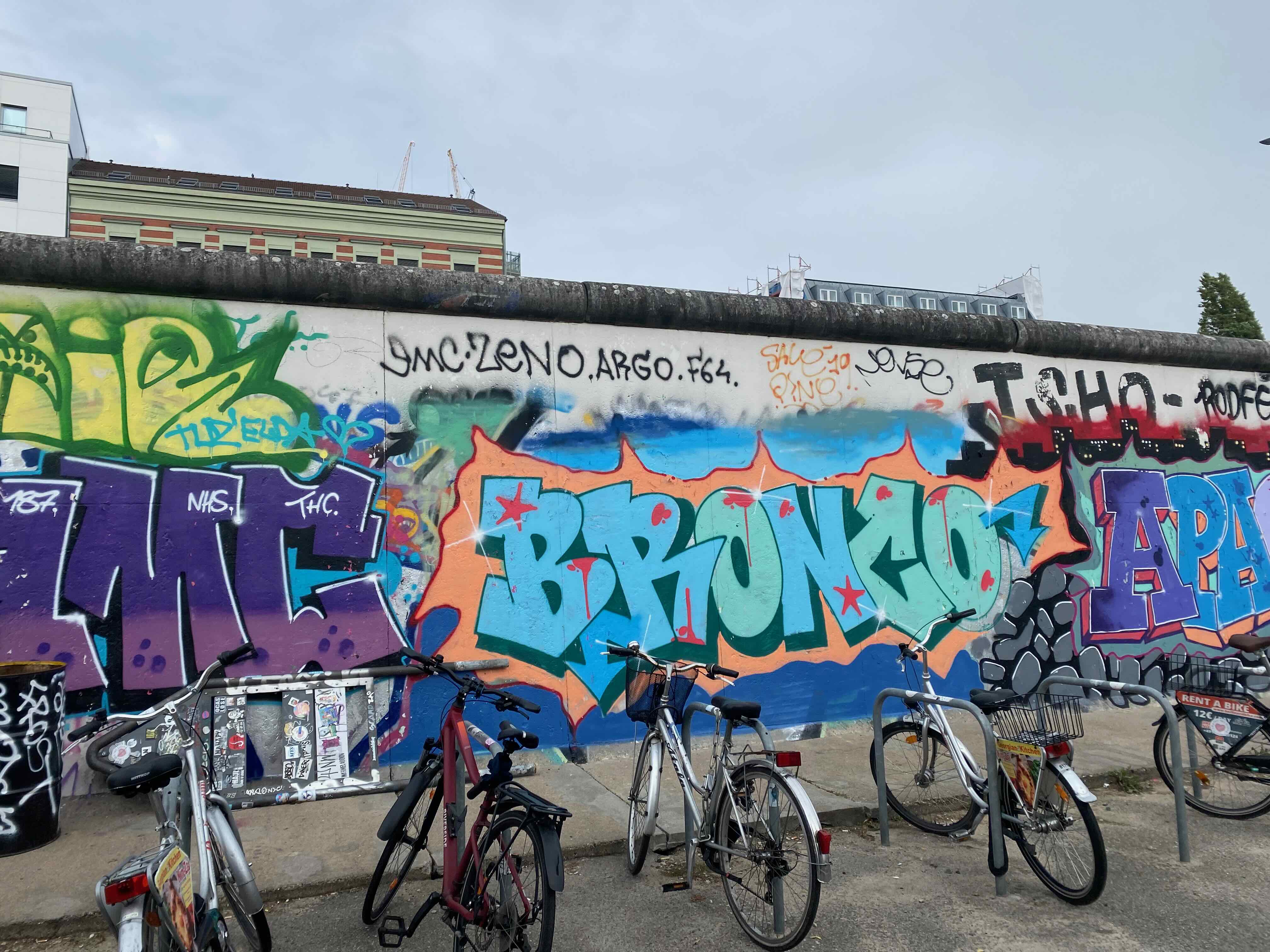
She explained that the graffiti was done on The Wall by people from all over the world immediately the wall began to be demolished in 1989. I took some photographs but they’re really not that good. Being there was the best thing.
We had walked along The Wall, on what had been the Russian Zone. Immediately on the other side of the wall it was still the East and the border for the West was on the other side of the river. And of course… a wide dead zone between The Wall and the river. It doesn’t bear thinking about. I can’t imagine what it must have been like to look out of your home and see that barrier knowing that some of your relatives were out of reach on the other side of the river.
Of course many people tried to escape and very few made it. We had seen some memorials on the fence when walking the day before. I’ve posted a photograph below.
We visited The Wall Museum afterwards and by the end I had a much greater understanding of what the German people on the East had to endure. Splitting families and holding people in a country where they don’t want to be just seems barbaric.
We watched interviews with escapees who succeeded and those who didn’t but survived. We saw photographs from the period1945/6 up to 1961 when there was a little more freedom of movement between East and West. We then saw the agony which began on August 13th 1961.
Of course there is so much political history and the subject needs much greater research and serious study to make any real comment here on my blog. I suppose what I can say, is that prior to my visit, I had only superficially thought about Germany after the war and now I have come to realise what a dreadful time the ordinary Berliner had. That child of ten had no comprehension of the division of Germany and Berlin between the Allies (France, Britain and America) and the Russians.
Looking West Across the River in 2022Looking over the Wall from West to East in 2022
Below is a Slide show of the East Side Gallery
A little bit of 2022 Graffiti on the West Side of the Wall. Apparently it is privately owned and the owner doesn’t mind.
My next blog will cover Thursday, Friday and Saturday in Berlin. Potsdam Palace, Bratwurst in Savigny Platz and terrific brunch in Arminius Markt!
The English Girl In Leningrad was published at the end of April this year. The author Anna Wooster agreed to answer some questions for this blog. I think you’ll find her answers fascinating. Anna’s story is the kind of story people want to read. It’s interesting from the point of view of Russian history, and Anna’s personal account of life as a ballet student in the Eastern Block during the cold war. Read on to find out more. . .
Tell me a little about yourself and life today.
In a way my life underwent a big change with Covid 19. Not because I caught it but because it coincided with a heart problem I had which interfered with my teaching routine. Simultaneously the ballet school had to close down because of the lockdown imposed in Italy. With ballet schools closed for practically two years, my class of senior secondary school girls dispersed; mostly gone on to university. However now I still give a weekly class and theory session to my group of four teachers who run the school, teaching children from 3 to 14, in six separate groups. I help with performances, and revive some of my choreography and rehearse my teachers when they dance themselves.
Apart from the school I seem to be as busy as before but there is far less to show for it. Writing the book was very time consuming and getting it actually printed was the most stressful part of it. We have a big house and let two flats as Airbnb accommodation which takes considerable energy and organisation and then we have an enormous garden, with flowers, lawns, vegetable patch, fruit trees and twenty olive trees which supply us with delicious oil all year.
My husband is on pension but since his retirement he divides the chores with me and takes the whole responsibility for the olives and veg patch. Our large extended family is scattered all over the world with a daughter in Australia, a son in Portugal, a grandson in Australia, another in America, and yet one more in Scotland. My eldest daughter, and her eldest son fortunately live only half an hour away from us.
Did you always want to be a ballet dancer?
Yes. Like many little girls I said I wanted to be a ballet dancer even before I really knew what that meant and even less what it entailed. I needed to do something completely different from my brothers. As I grew older and luckily found an exceptionally valid ballet teacher in Mrs Nina Hubbard my wish to do specifically ballet grew and with it a particular delight in doing ‘improvisation’. This was a field where I didn’t have competition from my brothers and where academic abilities didn’t come into play. At primary school I was what they called ‘a late developer’. I was slow to read, hopeless at arithmetic, and a lousy speller. However by the time I finished secondary school I had seven GCEs including English language, literature, maths, and French. The more ballet classes I did the better my academic work became. When I went to Warsaw for the Youth Festival aged 14+ in 1955, I knew I wanted to be a ballet dancer and no-one could discourage me. This one-mindedness has been a deciding factor in my life.
Tell me briefly, for my blog readers who don’t know you or the book, how you came to be a student in Russia please. I believe your father had a great deal to do with it. By the way he sounds like a wonderful man, I should like to have met him.
Yes, my dad was a wonderful person, and without him I would never have made to Leningrad. Mrs Hubbard was Russian and taught ballet pre-Vaganova Russian style. She was the one who encouraged me to aim at studying in Leningrad. My father read an article in the Times, written by a Russian diplomat saying that peace and understanding between nations would be increased with the exchange of students of science and the arts. Answering this appeal my father asked if the desire of his daughter to study ballet in Russia certify for this possible exchange. To cut a long story short, this beginning led to me being given an audition to the Bolshoi school during the Moscow Youth Festival of 1957, which finally enabled me to go to the Vaganova Academy in November 1957.
The training you received in Russia was very different from anything in the west and when you returned to England you found you could not fit in. Tell me about this.
The attitude to ballet in the Soviet Union was totally different to the attitude in the west. In Russia ballet was a main stream art, in England then, it was considered elite entertainment. I came home full of hope, anxious to put to use the accomplishments I had achieved, only to realise bit by bit that they were not what was requested. All my friends, teachers, acquaintances, contacts , were left behind the Iron Curtain. There was no-one to guide me, advise me, encourage me. Coming straight from the Vaganova Academy, from being pampered and looked after by dedicated teachers, from working in the best possible studies and theatres, I found myself rehearsing in church halls with terrible floors, rickety barres, no mirrors with ballet masters that seemed to me to give classes that tied me up in knots. The impact of cultural shock that hit me was gradual in its undermining power to destroy self-confidence, however, slowly but surely it eroded my very will to live: I was on tour in Chester, poised on a landing leading down to the river Dee ready to get finished with it all, when a casual call from a colleague “Coming for a drink Woos?” changed the course of things.
You say in your book that you had to choose between being a ballet dancer or marrying the love of your life. Because you felt dance was a vocation and demanded your whole self. How did you find combining being a ballet teacher with being a wife and mother?
On marrying I decided that ballet would not be my one and only object in life. However three months after settling in Riva del Garda in collaboration with the local music school I opened my first ballet classes for girls.
I decided right from the beginning that the ballet school would not be another all-absorbing career. I never programmed lessons at the weekends, nor taught after 7pm in the evenings. School summer holidays, Christmas, New Year, Easter, were all dedicated to the family, and I kept one weekday free from teaching so I could do things with my kids. That said, life was a bit like a merry go round; school, kids, husband, house, garden. Sometimes one would have priority over the others, for example when the annual school performance came up at the end of May beginning of June, everything else took second place. But preparations for Christmas, making of cakes, mincemeat, puddings etc the precedence changed. My two girls and my son all did ballet with me, the eldest up to a teaching diploma, and the second daughter up to advanced standard. My son danced until he was 12, then he oped for other activities, ski-ing, sailing, tennis and football that he started when he was 8. My husband collaborated with the school in a practical manner, helping with the maintenance of the studio, lending his secretary to keep the books, driving the van with costumes to the theatre, making scenery, you name it.
Have you now completely retired from teaching?
As I said earlier I still teach my group of teachers, and conduct the odd rehearsal. The lessons offer a good opportunity for them to ask any queries they have about their pupils, or doubts on how some step should be performed. They ask me my opinion concerning their choreography, and particularly advice on making costumes. Life has changed, pupils have changed, attitudes have changed, parents have changed. I have great admiration for my teachers who face many difficulties and obstacles that didn’t exist in my day and accept they must adjust to the times in order to survive, nonetheless they do so still upholding my principles.
Have you always thought about writing this book or did it only come to you recently?
No, I had never thought of writing a book. I had a very low opinion of my literary abilities, although I enjoyed essay writing at secondary school. I felt my literacy in English stopped when I was 17 and went to Russia. There I learnt Russian and I must say quite a bit of English too while trying to understand Russian grammar, but I read very little English. Then when I married I learnt Italian, there again English took second place and it wasn’t as it is now with TV in any language you want. In Italy they have the habit of dubbing all films in Italian too. It was doing the RAD BADE degree on Dance in Education by correspondence that really revived my English. We had to read copiously and write many essays. Because many students were not mother tongue English speakers, and I was living in Italy maybe they took me for a foreigner, but all the professors I had contact with complimented me on my English! My morale was very boosted by this. The idea of the book was connected with my degree insomuch as it was Jonathan Still, professor of the Music for Ballet course who encouraged me to write down my recollections. I sent him a photo of me in my Russian costume, the one on the cover of the book, and a description of the costume and how I made it and the adventure of getting the materials sent from England. He was most enthusiastic so I took another photo of me in the Arabian dance from Nutcracker and wrote about how I was chosen to dance this, and the rehearsals, the costume, and finally the encouragement from Nureyev who was the Nutcracker Prince at my first performance. I showed these efforts to my granddaughter too and she was fascinated and said straight away, “ Grandma, you must write a book about it all!”
You must have mountains of notes written over the years or did you just rely on your memory?
I haven’t written notes but I did write letters home to my parents when I was there and my father kept them all and put them is order by date and scholastic year. Those are the backbone of the book. Then I am afflicted by the squirrel syndrome, I never throw away programmes, photos, letters, press cuttings nor even postcards. However there is much in the book that comes from my memory, many of the sensations, anguish, joy, trepidation, wonder are there in my mind’s eye and add flesh to the facts from the letters.
How long did it take you to write the book?
The first write up, the one about the costume I did in 2016. The others followed at irregular intervals. During Covid lockdown I put it all on the app. Scrivener with the assistance of Jonathan Still. Then it really began to take shape. It was more or less finished by the middle of 2021.
How did you find self-publishing?
That was the worst part of all. I am not computer-minded. I am more or less self-taught or maybe it would be better to say, grandchildren- reliant ! Following advice from friends, I had the book professionally edited, and then sent it to a typesetter who prepared the files for KDP as that was the only way of publishing I could afford. There were hitches, and I am not 100% satisfied with the result, but it’s out, there to be read.
That’s the important thing. So much better than leaving it on your computer. What a waste that would be.
I remember you had originally wanted to print over 100 photographs but found that wasn’t viable. It looks like you ended up with around 30. How did you choose which ones to remove? How did you choose those?
Actually there are twenty-one photos with the frontispiece. First of all I was strongly advised by my editor to remove any photos which I didn’t have copyright for, which unfortunately were photos taken by professionals and were some of the best. I took out photos of buildings, and inanimate objects. Then I allowed myself only one photo of each role I danced, and one photo of the most important people in the story. I choose the photos where I think I look okay!
Ha… I don’t blame you!Do you ever go back to Russia now? To Leningrad or St Petersburg as it is now? Do you still have friends there?
Yes, I went back to St Petersburg last time in 2005, and went back to school and looked up those friends who were still alive and still there. Many, many people, teachers, classmates, friends, have died and many others have gone abroad. I saw my character dance teacher and the French language mistress. The group photo of our graduation year 1961 is hanging on the wall on the staircase. I saw a couple of friends and visited them at home. They now work either as teachers at school or in the theatre but life has altered tremendously.
I have been to Moscow much more recently in 2019/20 to visit my son and his Russian wife and son who live there.
Have all your family read the book and what did they think of it? You must have grandchildren old enough to read it now?
Yes, indeed. My granddaughter was my first reader, she has followed all the stages and has been a continuous stimulus to write the book. She was also an excellent critic, pointing out where I should delve deeper, explain more fully, or had been ambiguous. My second daughter too read it while it was in the making and contributed with many useful suggestions but above all designed the cover. She herself is a very eclectic artist, making use of an infinite variety of materials. It was her idea to use the Union Jack and the Hammer and Sickle as a background. My eldest daughter made a significant comment, she said “I was astounded how four years in Leningrad, formed your character, made you what you are, influenced your whole life!”
That’s very interesting. Often children don’t get the opportunity to read about their parents’ past.
My eldest brother and his wife who is Russian but comes from Moldava read the book in the making. My brother corrected my English and some family details and said chapter 4 was only for people interested in ballet! His wife on the other hand was enthusiastic about it and said it painted a vivid picture of a historic period. My husband read various parts along the way but feels he knows the story anyway. He too, finds there are too many ballet technicalities for a lay person.
I have had delightful messages from other members of the family, a cousin, father of three girls aged 12, 10, 7, read the book to them and they were fascinated and asked me all sorts of questions.
The cover shows such a lovely photograph of you, in a fantastic headdress. I believe your father had something to do with it?
Yes, my dad made the ‘skeleton’ of the kokoshnik, the traditional Russian headdress, from stiff wire recuperated from the stems of a bunch of artificial roses It was very difficult to find any materials like wire; there were no hardware shops or DIY stores. The roses were given to us by the theatre, they came from the opera Carmen! He made it in such a way that it was very sturdy and didn’t wobble at all. Then I covered it with lining and then lamé and we sewed on the ‘jewels’ and made the net of seed pearls which cover the forehead.
Did any of your children want to become ballet dancers?
Fortunately, no! None of them had all the qualities/gifts necessary for a career in ballet, and although they all had good points and gained joy and satisfaction studying ballet they developed other passions. My parents were very good about letting me do what I wanted to do, going against advice from school teachers and the like, and I was adamant that my children would make their own decisions too. They did, and all chose arts rather than sciences.
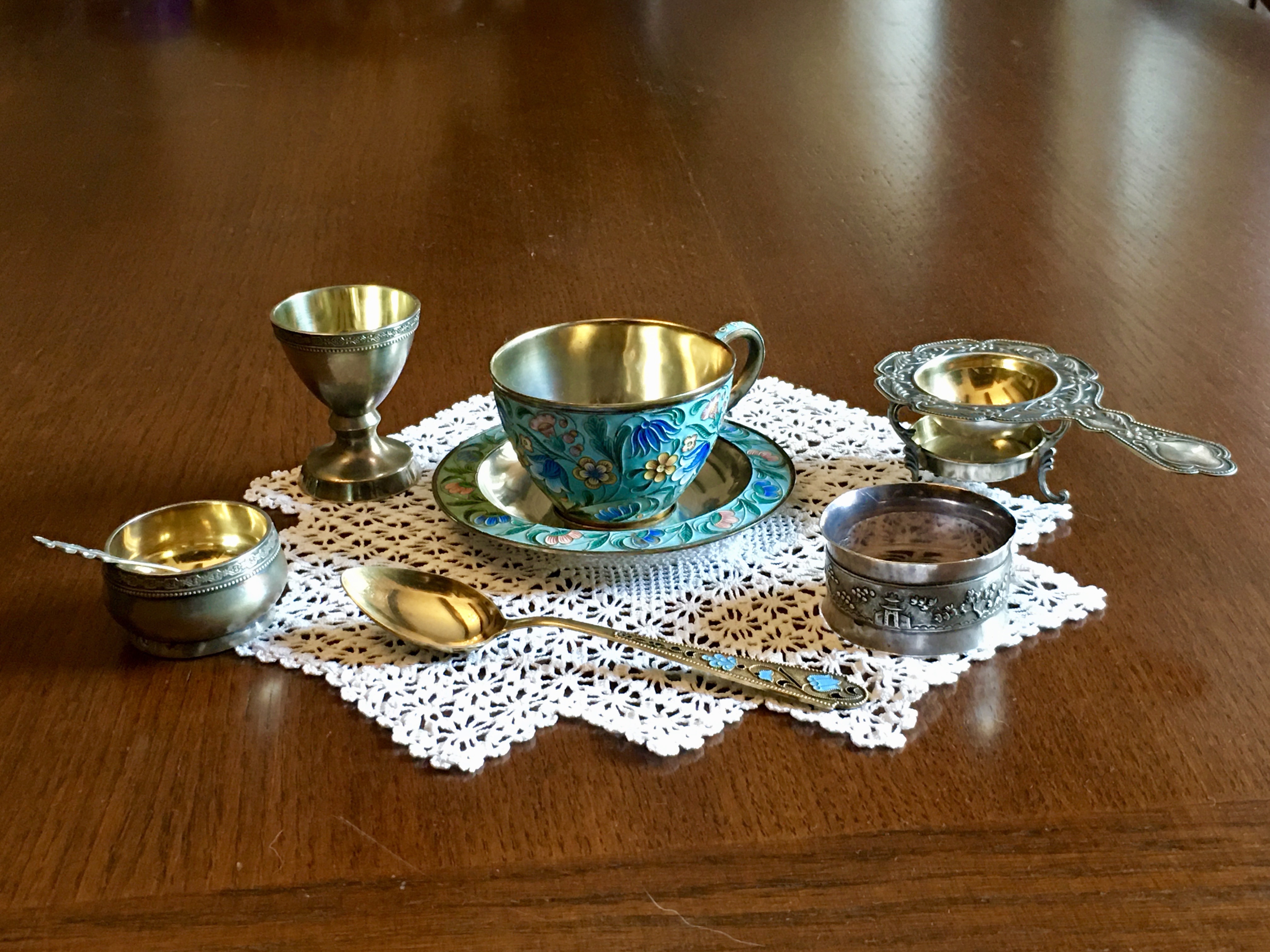
I love the story about selling all your clothing before you left and everyone wanting to buy items even if they were worn out. You bought a liqueur set as a memento. Do you still have it?
Yes, indeed! I treasure it together with the gifts that Olga Genrikhovna gave me.
Liqueur Set
Gifts from Anna’s Ballet Teacher
I understand you are at the moment translating the book into Italian, how is that going?
It is going reasonably well. I did a rough translation with the Deep L. App. And am now reading through it to correct the most blatant mistakes, (like translating ‘the rake of the stage’, as though it was a gardening rake!) But when I have done that it will need to be edited by an Italian, then typeset for KDP, which I am wondering if I can manage myself this time…. Ah! Still a lot of work to do on that, but very necessary because all my pupils are Italians and although the younger generation is much more proficient in English than former ones, none of my teachers for instance have read the book and I do want them to read it!
Can we also expect it to be translated into Russian?
Maybe. My Russian sister in law has offered to help me if I decide to translate it into Russian. It would be a very good exercise for my Russian which has become very rusty, particularly the reading and writing of it. I don’t know who would be interested in reading it in Russia now, everything has changed so much….
Do you think this is the only book you have in you? Or can we expect another perhaps more about life as a dance teacher in Italy?
Good question! There has been considerable pressure put on me by my ex pupils here in Riva, to write up the fifty year’s story of the ballet school. I have stored and kept much information about the school and its transformations over the years and have loads of photos and videos. (From the 80s on) and my memory is not too bad so it’s not impossible that I’ll write it all up sometime…
I’ll be watching out for that one!
Thank you Anna for answering my questions and congratulations on producing such a wonderful book.
Once I began reading it I could not stop and I recommend that all my followers download the e-book or order a copy of the paperback so that they can judge for themselves. Anna’s website can be found HERE Link to buy the book HERE
This is a first for this blog and I hope it won’t be the last. I’m delighted to be joined today by Sim Alec Sansford and Chantelle Atkins who are going to answer some questions about their book Fortune’s Well it’s the first book in their series and it’s called Hangman’s Revenge . The interview makes fascinating reading and I’m tempted to try writing something with another author myself. I’ll have to put out the feelers.
Welcome Sim and Chantelle. Thank you so much for joining me on my blog today.
First of all, a little bit of blurb about the book:
Book blurb:
In the town of Fortune’s Well a dangerous storm is brewing, and two unsuspecting teenagers are standing right at the heart of it.
For JJ Carson, life has not been easy. His father is dead, his mother arrested for the murder, and he has been forced to live on the farm with his alcoholic uncle, Henry.
Just when things could not get any worse, JJ discovers his living situation is not the only thing that makes him different from the other kids. A dark, swirling mist has made itself at home inside him and it is slowly changing him from the inside out.
Enter Darcie Duffield. Beautiful, popular, and incredibly misunderstood.
Darcie is sick of the status quo and wants to make a difference. After a chance meeting with a strange boy at the river she becomes tangled in a web of lies and deceit stretching back generations, as she tries to help save him from the darkness lurking within.
Why is this happening?
Where has it come from?
And why is Darcie the only one who can see it?
Welcome Sim and Chantelle. Thank you so much for joining me on my blog today. I’m going to throw quite a few questions at you both and here’s the first one:
How many books have you each published so far?
Chantelle: I’ve published 14 altogether.
Sim: I’m still a bit of a novice. Currently, I have one novel and a handful of short stories/novellas.
What genre?
Chantelle: A mix of adult and young adult. Coming of age, psychological thriller and suspense, family drama and mystery and crime, plus dystopian! Oh, and short stories and poetry.
Sim: I’m a firm believer in writing what you love to read, so I predominantly write Young Adult Paranormal Mystery. Although I am currently writing a Young Adult Mystery which I am enjoying.
What made you decide to write together for your latest publication?
Chantelle: Sim joined me as a director in my company Chasing Driftwood Writing Group and not long after that he asked if I’d ever consider writing with another author. I hadn’t and I’d often wondered how such a thing was possible! But we got on so well, had similar writing styles, and a mutual love of YA and character driven stories, so I thought why not?
Sim: As Chantelle says, we’d worked so well on a few writing-related projects (workshops, competitions, events) before so to me, the next step for us was to create something together. I first had the idea for a story that would take something negative (anxiety, depression) and turn it into something positive and magical. I knew I could never do the story justice alone, it needed a dual narrative, so I asked Chantelle and hoped for the best. Having become a fan of her work, I was blown away when she said, “Yes!”
Have you known each other long?
Chantelle: I first met Sim at Blandford Literary Festival in 2019 so not too long!
Sim: No, not long at all. But strangely it feels like I’ve known Chantelle my entire life. I’m pretty sure the feeling is mutual too. We’ve actually only met in person once, which is crazy for me to even think about. Writing is such a vulnerable thing and I feel like I now know Chantelle better than I know myself.
How did you meet? Or how do you know each other?
Chantelle: We had a mutual friend in Author Paula Harmon who was running Blandford Literary Festival as well. So, I met Sim there after agreeing to run a teen writing workshop.
Sim: It’s really funny actually. I remember the first time I spoke to Chantelle. I’d been running the website and social media for Blandford Literary Festival, so I’d seen her photo and info and thought she was so cool. Her books looked edgy, and dark, and that’s completely my vibe. The first time I spoke to her in person was at an event where I bought one of her books, I was so nervous I think I just said, “This please.” Then ran.
How was the experience of writing together? Did you argue a lot or just get along fine?
Chantelle: We didn’t argue once. We started with a basic idea that Sim had and both thought of a character. It just spiralled from there, with us messaging each other via Facebook to suggest plot lines etc. I wrote the first chapter and Sim responded and so on.
Sim: We just gelled together so well. We’re very similar in a lot of ways and very different in others. We see each other’s strengths and we build each other up. It was scary for me, writing with someone who already has a large catalogue of books. But it was new for Chantelle to tackle the paranormal genre, so we both taught each other things as we went. It really just flowed and took on a life of its own. I’m not sure if we are just the luckiest authors in the world, or if it was pure fluke, but it’s lasted for three books now and hopefully many more to come.
Can you talk us through the process?
Chantelle: It was all on Facebook messenger! Back and forth, suggesting ideas, messaging each other whenever we thought of a twist! It happened fast because each time one of us sent a chapter, the other would read it and get so excited they would instantly respond!
Sim: Like Chantelle says, it was very organic. Whenever we encountered a plot hole or character arc, we talked it through on messenger and found a way around it in no time.
What made you choose YA supernatural?
Chantelle: We both love YA, reading and writing it. Supernatural was a new genre for me personally but I’ve really enjoyed and embraced it now.
Sim: I am a huge fan of the supernatural/paranormal genre. This goes for everything from books to TV shows, movies, and even video games. I was a big fan of R. L. Stine’s Goosebumps series as a child, I loved the bizarre twists and horror elements. As I got older, I fell in love with series like The Twilight Saga (Stephenie Meyer), The Halo Trilogy (Alexandra Adornetto), The Elixir Trilogy (Hilary Duff & Elise Allen), and my current series read, Vampire Academy (Richelle Mead).
Did you write together, sharing each chapter or did you work separately?
Chantelle: We decided early on to write chapters separately from our characters point of view and swap back and forth.
Sim: It was important for us to each have our own protagonist to focus on. It helped us keep the characters believable and we could maintain our own style. Of course, our characters do cross paths, but we had a lot of trust in each other. The characters also seemed so real to us both, that it was easy to write each other’s as if they were a living, breathing person.
How many hours a week did you work together?
Chantelle: Ooh not sure, but we were constantly messaging every day!
Sim: I can’t give you the specifics, but I can tell you it felt like 24/7.
How often did you exchange work?
Chantelle: Sometimes every day, sometimes a few days would pass between chapters.
Sim: Let me tell you something about Chantelle Atkins… She’s not human! Chantelle was an absolute machine when it came to writing these books (bearing in mind she was writing her own four-book series at the time whilst working and being a mum). We were pretty good at doing a chapter each and sending it over within a day or two. However, there were a few delays (mostly from my side) when life would get in the way. For the most part it was quick. We completed all three books within eleven months from the original conversation.
Did you create and develop the characters together?
Chantelle: We came up with our own, but I feel like they developed alongside each other. To start with for instance, we were both conscious of getting the others character right when they were in our POV chapter but once we had gotten to know them better, it came easily.
Sim: I agree, writing each other’s characters seems second nature now. That includes the minor characters. Remember, these are teens, so they have their own friend groups, family, teachers, bullies etc. I think the thing that helped us here is we both really knew who these characters were. Whether they were a parent or a student, we knew the characters inside out.
Who came up with the idea for the book?
Chantelle: Sim!
Sim: Me. Although Chantelle wrote the first chapter, and she completely captured the world I wanted to create. I couldn’t have done it without her.
Any advice for others who are thinking of writing jointly?
Chantelle: Definitely pick someone with a similar style and genre. Keep messaging and communicating!
Sim: As Chantelle says, communication is key. It will only work if you’re one hundred percent authentic. As we’ve proven here, writing “pedigree” doesn’t matter. Number of books is irrelevant. You need to find someone you trust who shares your visions. Someone who knows your weak points and your strengths and is willing to work with you to create something together. It’s all about teamwork and friendship.
What was the best thing about writing together and the worst thing?
Chantelle: Best thing was how addictive writing it became and how much we fell in love with the characters. I can’t think of a worst thing!
Sim: I agree! It was so exciting because you got to be a reader and a writer. Eagerly awaiting the next chapter and not sure what to expect. I guess for me the only negative was not having more time in the day to write together due to our other commitments.
What’s the next move for both of you?
Chantelle: Our company (ChasingDriftwoodWritingGroup.org) is putting together another anthology so we will be working on that together. For me, I’m working on a four-part YA post-apocalyptic series. It’s pretty much done but the first book is with beta readers, so it’ll be a while until it’s all ready. I also have a few other works in progress on the go!
Sim: Along with plans for future literary festival events (BlandfordLiteraryFestival.com) and working on various projects for our company; I am working on a YA Mystery book right now. I started the story for a university assignment sometime around 2012-15 but lost the original file. So, I started again last year from scratch, and it’s been so fun to write. I am also working on the second book in the Denver Falls Saga, the sequel to my debut novel.
Any plans for writing another book together?
Chantelle: Yes! When Fortune’s Well is fully released and done with, we will start writing another series together. This time it’s an idea I had that I think will work well in the same way. It’s a dystopian, post-apocalyptic story called The Few.
Sim: Of course! I can’t wait to get started on the next one. We have also discussed working on prequels and sequels to our Fortune’s Well series (both novels and short stories), but there’s nothing concrete right now.
A couple of fun question now:
Do you both have animals? If yes, what and what are their names?
Chantelle: Yes, I have two scruffy lurchers called Tinks and Jesse, plus various ducks, and chickens!
Sim: I have two adorable dogs, Bilbo and Buddy, and three cats named Willow, Sam, and Susie.
Have you googled yourselves?
Chantelle: Last time I did it said I had died. But it turned out to be an Eastenders character!
Sim: Yes! Mostly to check there were no embarrassing Facebook photos of me appearing now that I’m an author and publishing under my real name. I’m pleased to say it’s all book related. Sadly, no Eastenders characters. I guess I’m one of a kind!
If you could spend a day with your favourite author, who would you both pick — apart from each other or me!
Chantelle: Stephen King without a doubt.
Sim: I have to say I agree with Chantelle on that one. King is writing royalty!
Thank you for a great insight to yourselves and your writing process. I’ve really enjoyed asking the questions and reading your answers. I plan to do more of these on my blog. So, readers, look out for the next one!
I was going to save some of this news for my actual newsletter but I want to keep everyone in the loop as to what has been going on.
First of all Dear Tosh has been shortlisted in The Selfies Book Award in the Autobiography and Memoir category. I am so thrilled about this and look forward to hearing the results next Tuesday 5th April. Watch this space only don’t hold your breath.
Secondly the lovely Clemmie Telford featured my list on her website ‘Mother of all Lists‘ and I had the most amazing response on Instagram with many people saying how much they could relate to the things I wrote. Especially those who have suffered adult child bereavement or sibling bereavement. I was overwhelmed by their comments and the love that poured out. You can read it here if you haven’t already.
Newsletter will be out next week and it will be coming from France! (If we ever get packed!)
Town Hall Barnsley. Photo from Barnsley Town Hall website.
I was writing a dual time line novel set partly during the second world war and partly during the 1950s. For certain reasons, I decided to set the story both in a small fictional town in Yorkshire, and in a small district of North East London. My protagonist hailed from the Yorkshire town. As I am not from the north I felt I should do some research before the second draft and editing of said novel.
It was an eye opener!
I spent only three days in the town of Barnsley, in South Yorkshire. I was shown the local sights by a friend who lives there (thank you Helen) and I spent several hours in the museum, and archives department at the town hall. The visitors service assistants in the archives were absolutely fantastic. They searched out old maps, magazines, newspapers, photographs and took time and care to show me how to find the resources I needed. I wish I could have spent longer studying there. It was a joy, honestly, I loved it. Fascinating reading about other people’s lives and their memories of growing up in this town.
But. . .that’s the nub of it: Other people’s lives.
The result of my research was a massive reality check, and frankly a blow to my hitherto confidence in my ability to write about anything and everything. I realised that I had romanticised my protagonist and underestimated what my small town in Yorkshire might actually be like. The more I found out the more I saw massive plot holes in the story and flaws in my characters. I have rethought the whole thing. Even though I had written 85,000 words and now edited 20,000 of them I thought of what my son Matthew said to me a few years ago: never be afraid to put it in the bin and start again.
I realised that writing about the north/south divide with my protagonist hailing from the north and me, a writer from the south was neither ethical nor indeed possible. How could I have the audacity to try and write from her point of view?
It made me see that I should write about the things I know. There would be nothing wrong with me writing a war story set in Greater London where I was brought up. I would still have plenty of research to do but I could draw on my own family history for much of it.
Onwards I go. . . but now with a different genre, different time and different story!
Please leave a comment if you have the time, it would be appreciated. Thank you. 😊
There are a great deal of posts on Instagram, Twitter and Facebook, and podcasts etc., all about loss and grief. It is spoken of more often today than in the past. Especially over the last couple of years it seems. We are encouraged by social media to talk about our losses and share our feelings..
Last Friday, the 14th January, was the eleventh anniversary of the loss of my lovely son Thomas Hartley. Last year I wrote a book about him and for him, for the tenth anniversary. This book is called, Dear Tosh. This year, I didn’t write another book, but The Man and I went to Dartmouth and visited Dittisham where I used to holiday with my children when they were all younger. It was a trip down memory lane. 😊
I try to write in my journal every day. Here I can write what I like and not worry about anyone reading it. . . not until I’m dead anyway. In my journal I can be honest, say what I really think but even then I hold back a little bit, just in case I leave it somewhere and another pair of eyes read it. I don’t like to, pour out my grief on social media, but sometimes I just write a paragraph or two hoping people will understand what it’s like to lose a child, even when that child is 27. Writing about it does help. At least, I think it does. I wrote my book as a tribute to Tosh, I didn’t publish expecting it to become a bestseller.Dear Tosh is slowly finding its way around the world and I’m happy to report that readers have reached out to me, often saying the the book has helped them with their own loss, or they finished it and gave it to someone else they knew who had lost a child.
This year I have found the anniversary of his death harder. Many people would say that’s not right, and that by now I should be okay. I should be ‘moving on’ and forgetting about the past. But I just don’t think that’s possible. My daughter and I exchanged text messages yesterday (the 15th January). She was feeling upset about things and I told her this: I feel low too. . .almost worse than yesterday. . .It’s like I don’t want the anniversary to be over. . .it just means I’m even further away from Tosh. 🙁 She replied: Yes I totally relate to the further away thing. It’s weird isn’t it?
I wonder if other bereaved parents and siblings feel the same way? It’s as though you cannot or don’t want to let go. Clinging on by your finger tips to stop them slipping away.
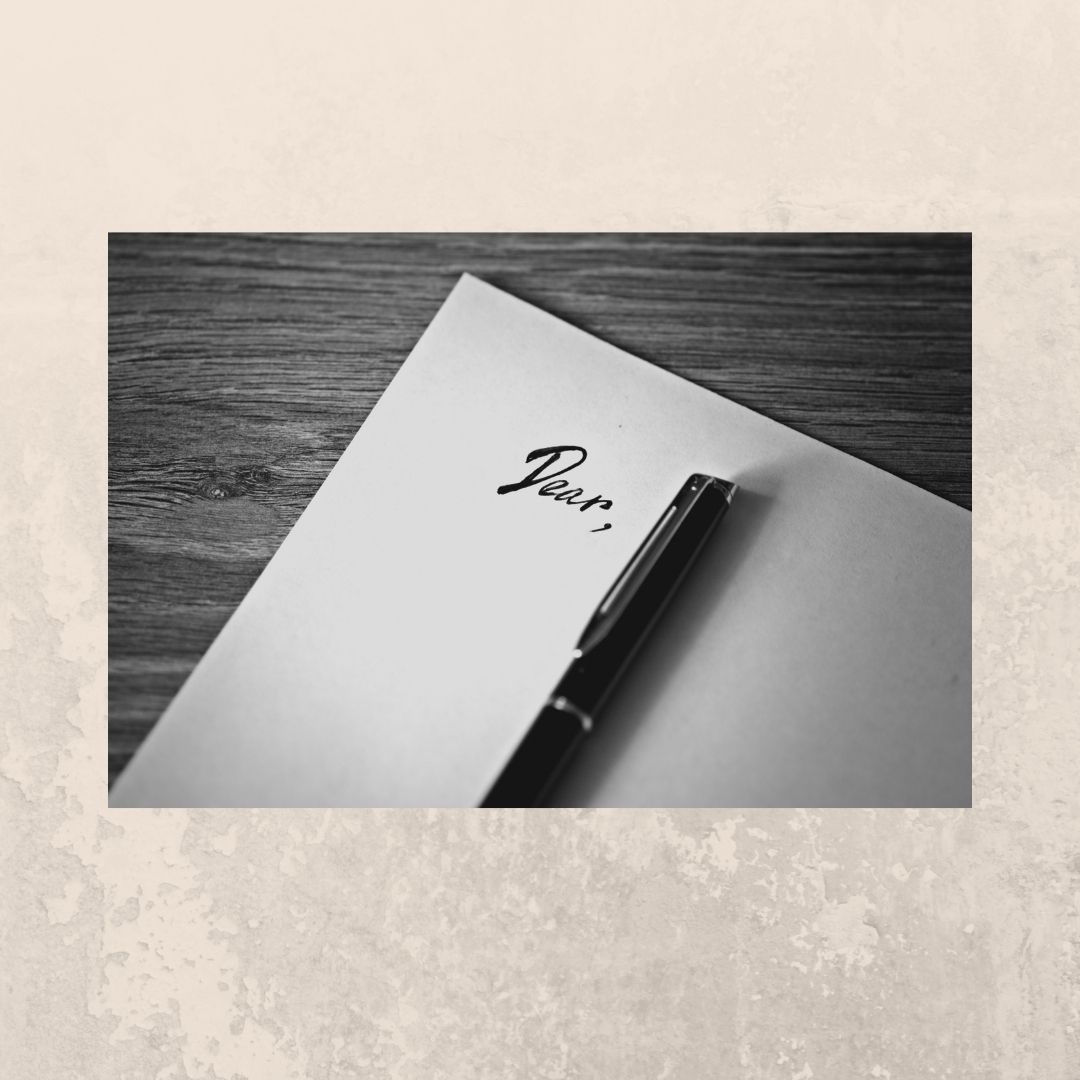
I miss writing to Tosh, that’s the format of my book, twenty seven letters written to him. I have missed writing him those letters, and I think I’m going to write a few more. I did scribble a note to him while we were away for his anniversary. I used the hotel’s headed note paper and told him what we were doing and how things were for me. I folded it up and put it in my journal and I felt better.
I firmly believe that writing ‘stuff’ down is good for mental health. One can write in a notebook, on a computer or even a scrap of paper. It doesn’t matter if you’re a writer or not. It can be so therapeutic; getting things out of your head and onto the page. But. . . I have an idea for my blog readers. Why not try writing a letter to someone you have lost. A mother, a father, a child. . . anyone whose loss has affected you. Write them a letter or two, or more. Tell them what has happened since they died. Tell them things you wish you had said to them when they were alive. Ask them questions — you may find the answers to those questions just by writing them down — speak to them, tell them your thoughts. I’m sure it will make you feel better.
I’m going to write to my father who died well over fifty years ago. Who will you write to?
In the early hours of this morning, around 1.30am, I was awoken by a loud crashing coming from downstairs. Raising my sleep laden head from the pillow I asked, ‘What’s that?’
‘Don’t know’ replied The Man, mumbling half asleep. I didn’t bother him too much because he’s not well right now.
Immediately, I realised that I would only find out what caused the noise if I went downstairs to have a look. I pushed my feet in to my slippers and gingerly made my way down the cottage staircase. Strangely it never occurred to me that it might be an intruder. The dog never barks at anything so that was no indication. When I opened the door to the sitting room I was confronted by a quivering Jpeg, desperate to escape into the garden.
I switched on the main light — a horrible white glaring bulb — and then I saw. . .
Wait for it . . .
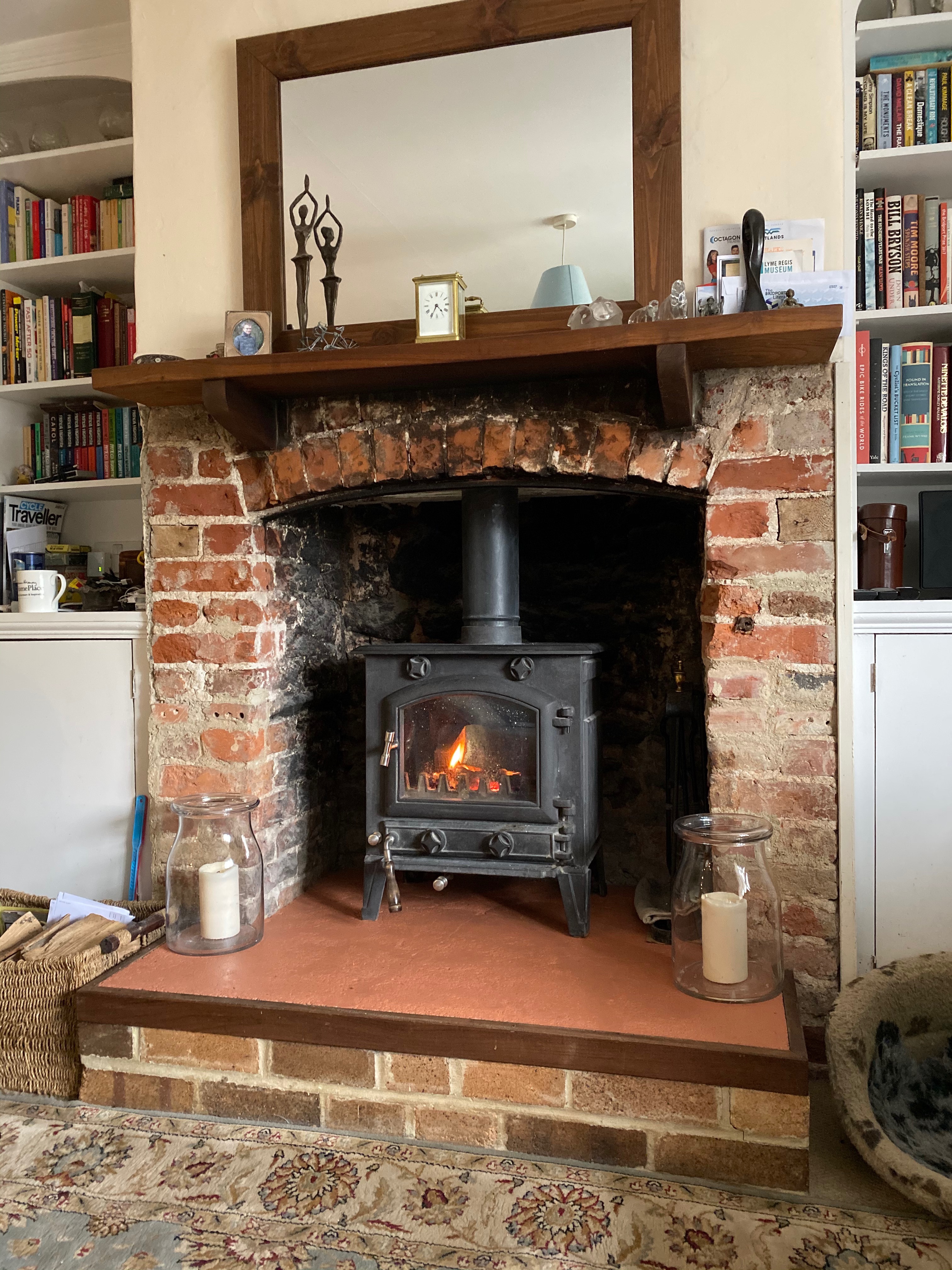
The huge mirror we have above the fireplace was no longer in situ but smashed to pieces on the floor. The odd thing was it was face up so all the pieces were still held in place. It must have just slipped down from the wall, taking most of the ornaments on the mantlepiece with it — only one of those was broken, an Ikea dancing woman. The family carriage clock had also fallen but thankfully it was completely undamaged, in fact, I think it’s keeping better time this morning than for months.
I managed to transfer the broken mirror from the floor to the kitchen table to be dealt with in the morning. I vacuumed up the tiny splinters that had found their way across the carpet. I then had to go into the garden with the dog’s lead in order to drag her back in. She’s very anxious these days. I comforted her for a while and when I thought all was well I went back to bed. As I left the room, I glanced at the wall above the mantelpiece which looked very naked and ‘un-homely’ — if there is such a word — and a little wave of melancholia came over me.
By the time I got back into bed I was wide awake and any chance of sleep seemed shattered, like the mirror. I began to think about the consequences — according to the Great Book of Superstitions — if you break a mirror etc., etc., but it’s all rubbish isn’t it? I managed to convince myself that all would be well as I hadn’t actually broken the mirror myself. But I touched the wooden bedside cabinet with my fingers, just in case, before I eventually went back to sleep.
Are you superstitious? I know my mother used to come up with all sorts of things: don’t pass on the stairs, throw spilt salt over your shoulder, never give anyone a knife for a present without giving a silver coin, no new shoes on the table. The list goes on and even though I say I’m not superstitious I cannot stop myself from adhering to some of those little rules.
We will have to replace the mirror but right now we’ve put a painting there. Hmm. . . maybe it looks better? What do you think?
Yesterday I was featured on the blog post of Meet The Authors. Of course now I’ve read it through I can think of lots more I could have said but too late now. Isn’t that always the way?
It’s a good interview (I think) and I’m posting the link below so that you can pop on over and have a look. Please leave a comment if you can — it makes a big difference.








































 Ninette Hartley